The MYTHENOR encyclopedia
Egyptian Mythology (Ancient Egypt)
Who they were
Egyptian civilization flourished along the Nile for about three thousand years, from the unification of Upper and Lower Egypt around 3100 before the common era to the Roman conquest in 30 before the common era. Nearly everything depended on the river: its yearly flood left fertile black soil in a narrow strip surrounded by desert. Egyptian religion gathered hundreds of deities, shown in human, animal or mixed form, and turned on ma'at, the harmony and balance of the world, which the pharaoh and the priests were meant to uphold. Temples were the homes of the gods. Magic, heka, was a real force, and writing was considered a divine gift: hieroglyphs were called the words of the gods. For the Egyptians, death was not an ending but a passage that demanded care, rites and memory.
Cosmology
In the beginning there was only Nun, the dark, undifferentiated waters of chaos. From them rose the ben-ben, the primeval mound, where the creator appeared, Atum-Ra, or Ptah in another tradition. From him came Shu, air, and Tefnut, moisture, and from them Geb, the earth, and Nut, the sky, arched above him. Nut gave birth to Osiris, Isis, Set and Nephthys, and Horus was joined to them. Each day the sun crossed the sky in a barque, and each night it passed through the Duat, the underworld, divided into twelve hours, while the serpent Apophis tried to stop the dawn. A person had several parts: the body, the ka, the ba, the akh, the shadow and the name. After death the heart was weighed against the feather of Ma'at. The just went on to the Field of Reeds; a heavy heart was devoured by Ammut.
Pantheon
Ra, the sun, was the great creator, with forms such as Khepri, the morning scarab, and Atum, the evening sun. Osiris, killed by his brother Set and restored by Isis, became lord and judge of the dead. Isis was the great magician and protective mother; Horus, the falcon whose eyes were the sun and moon, was the god of kingship. Set ruled the desert, chaos and storms, yet defended Ra's barque against Apophis. Anubis, the jackal, oversaw mummification and the scales; Thoth, the ibis, invented writing. Hathor was goddess of love and music, and as Sekhmet became a destroying lioness. Nut and Geb, Ma'at, Sobek, Bastet, Taweret, Bes and many others completed the pantheon.
In MYTHENOR
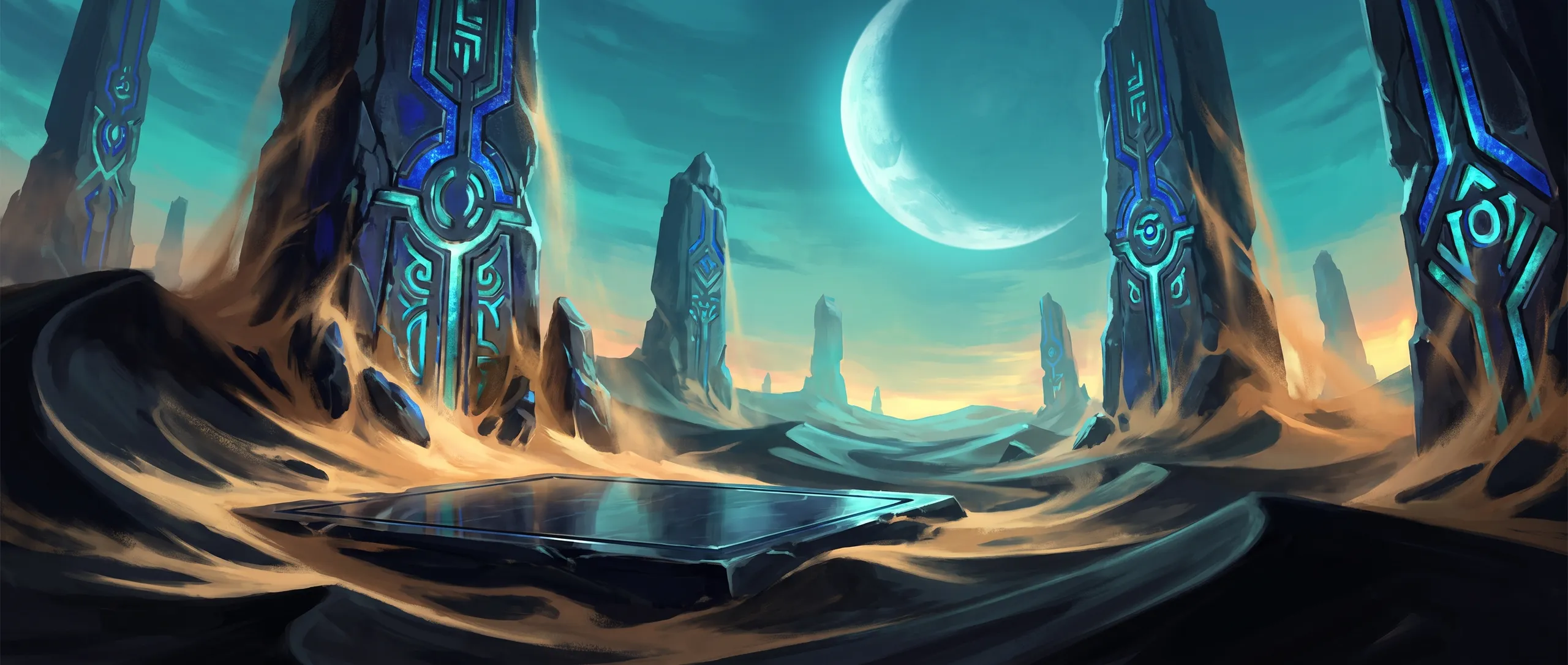
In MYTHENOR, Egypt is reinvented as the Obsidian Necropolis, under the Lapis Sky, with its own colors and names for the great deities: Kheperu, heart of the sun, Nehkarath, the star-devouring serpent, Sekhalu, falcon of the bronze dawn, and Wenmara, the jackal-guardian. There, erasing a name is the worst of deaths. The Chaos Serpent's seal is cracking, words fade from papyrus, and Merytamun, the last sentinel, guards the lapis thread. The playable character is Nakhtiu, the shadow reader.
A note on respect
The religion of ancient Egypt is not practiced today as a continuous tradition, but it is a central part of the cultural heritage of Egypt and of the world. MYTHENOR treats its gods and rites with respect, gives new names to the great deities so as not to caricature them, and always marks what is real myth and what is the game's creation.
Sources
- Ancient Egyptian religion — Encyclopaedia Britannica
- Ancient Egyptian Religion — Joshua J. Mark (World History Encyclopedia)
- Ancient Egyptian Mythology — Joshua J. Mark (World History Encyclopedia)
- Egyptian Gods - The Complete List — Joshua J. Mark (World History Encyclopedia)
- Ra (Egyptian God) — Joshua J. Mark (World History Encyclopedia)
- The Book of the Dead (introduction and chapter summaries) — E. A. Wallis Budge (Project Gutenberg)
The 120 cards
- Kheperu, Heart of the Eternal Sun
- Nehkarath, the Star-Devouring Serpent
- Sekhalu, Falcon-God of the Bronze Dawn
- Wenmara, Jackal-Guardian of the Eternal Gates
- Glass-Sand Wyrm
- White Desert Lightning Dragon
- Buried-Ruins Dragon
- Gold-Scaled Solar Dragon
- Molten Obsidian Dragon
- Royal Lapis Cobra
- Horned Dune Viper
- Serpent of the Bottomless Well
- Hot-Wind Serpent
- Turquoise-Spitting Cobra
- Serpent of the Black Horizon
- Serpent of the Sealed Chaos
- Jackal Sentinel of the Dunes
- Temple Fire-Swallow
- Delta Messenger Ibis
- Sandstorm Vulture
- Thunder-Falcon of the High Wall
- Ba, the Soul-Bird
- Falcon of the Rising Sun
- Lapis Tower Falcon Guardian
- Oasis Guard Lancer
- Chariot Archer
- Bearer of the Royal Khopesh
- Burning Sands Warrior
- Captain of the Burning Sands
- Medjay Bodyguard
- Wandering Dune Jackal
- Papyrus-Marsh Hippo
- Sacred Temple Cat
- Red Desert Lioness
- Crocodile of the Murky Waters
- Hyena of the Starless Night
- Knife-Cat Who Slays the Serpent
- Sekhara, Lioness of the Raging Sun
- Pack of the Desert Jackals
- Lioness-Headed Champion
- Jackal Guard of the Sealed Gate
- Ram-Headed Warrior of Elephantine
- Falcon-Headed Warrior
- Guardian of the Duat's Gates
- Jackal Judge of the Scales
- Sebeku, Crocodile Lord of the Oasis
- Ka, the Luminous Double
- Spirit of the Turquoise Flame
- Echo of the Forgotten Priest
- Shadow-Guide of the Dead
- Spirit of the River's Flood
- Akh, the Radiant Spirit
- Radiant Face of Dawn
- Daughter of the Moon over the River
- Keeper of the Eternal Threshold
- Voice of the Golden Thunder
- Weaver of the Night-Sky Stars
- Green Lord of the Harvest
- Protector Hippo-Mother
- Keeper of the Twelve Gates of the Duat
- Sand-Woken Mummy
- Servant of the Broken Sarcophagus
- Reaper of the Lost Tombs
- Black Linen Shade
- Wraith of the Sealed Necropolis
- Herald Beyond the Veil
- Forgotten King Beneath the Dune
- Mummified General of the Last Dynasty
- Scribe of the Forbidden Words
- Sorceress of the Turquoise Veil
- Oracle of the Eternal Flame
- Mage of the Lapis Circle
- Priest of the Word of Power
- High Priest of the Deep Temple
- Djehutar, Ibis-Scribe of the Moon
- Blue Faience Ushabti
- Copper Automaton of the Royal Guard
- Enchanted Reed Barque
- Bronze Colossus of the Buried Temple
- Awakened Ushabti Legion
- The Solar Barque of Millions of Years
- Star-Rolling Scarab
- Blue Lotus of the River
- Turquoise-Tailed Scorpion
- Plague Locust Swarm
- Scarab of the Rising Sun
- Ammut, Devourer of Hearts
- Lapis Lazuli Sphinx
- The Nameless King Awakened
- Bennu, the Bird of Renewal
- Blessing of the Turquoise Oasis
- Breath of the Solar Furnace
- Flame that Wakes the Dead
- Masks of the Beast-Gods
- Eye of the Sandstorm
- Whisper of the Quicksand
- Seal of Eternal Silence
- Wisdom of the Lost Scribes
- Wind that Erases Seals
- Tide that Returns the Past
- Curse of the Black Scarab
- Wrath of the Buried Sun
- Shield of the Silent Jackal
- Sand that Swallows the Aggressor
- Lapis Lazuli Mirror
- Seal that Drains Strength
- Living Obsidian Barrier
- Jaws of the Sacred Well
- Curse of the Violated Tomb
- Judgment of the Doubled Sun
- Ancient Bronze Khopesh
- Collar of Jackal Fangs
- Lapis Serpent Staff
- Embalmer's Bandages
- Golden Falcon Wings
- Necropolis Under the Lapis Sky
- Weighing of the Heart
- Riddle of the Sphinx
- Opening of the Mouth
- Rite of the Myrrh Nest