Egyptian · No. 069
Scribe of the Forbidden Words
Inspired by: Egyptian scribes and the power attributed to names: knowing and speaking a name gave power over its bearer.
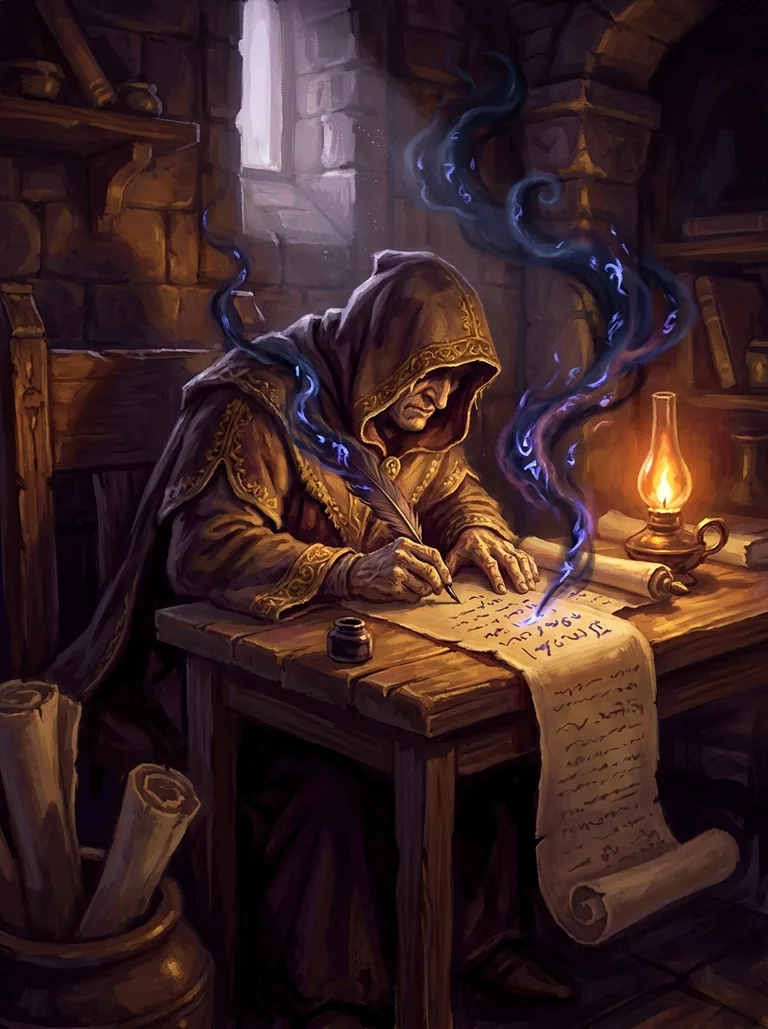
He writes names no one should read aloud.
- Rarity
- Common
- Category
- Monster
- ATK
- 1100
- DEF
- 1000
- Level
- 3
- Type
- Spellcaster
- Element
- Darkness
- Constellations
- Moon · Fox
The myth
In Egypt, scribes were highly respected for mastering writing, believed to be a gift of the gods; hieroglyphs were called medu netjer, the words of the gods. Writing had magical force. Budge explains that if the dead knew the names of divine beings, friends or foes, and could pronounce them, they gained power over them and could make them do their will. The Scribe of the Forbidden Words, who writes names no one should read aloud, is a MYTHENOR creation.
Why it has this power
A common level 3 Spellcaster of Darkness with 1100 ATK and 1000 DEF. Moon beats Wisp and Fox, cunning, beats Hammer. With the Delta Messenger Ibis it fuses into Djehutar, and it is a material of the Weighing of the Heart, which calls Ammut. The Lapis Serpent Staff gives it +700.
Did you know
Being a scribe was, in ancient Egypt, a real path of social advancement for those who mastered writing.
Connections
- Fuses into: + Delta Messenger Ibis → Djehutar, Ibis-Scribe of the Moon
- In Scribe Nefru's deck
- In Sethis, Novice Sentinel's deck
- In High Priest Khaymet's deck
- In Merytamun, the Last Sentinel's deck
Where to get it
- Comes in every duelist's starter deck.
- Campaign drop: Scribe Nefru (The Obsidian Necropolis) — grade B: 14% · grade C: 13% · grade D: 13%
- Daily Offering: 0% per pack (Common 64% per card)
- Welcome Pack: 0.97% per pack (Common 70% per card)
- Traveler's Pack: 0.88% per pack · 5.2% in the themed pack (Common 64% per card)
- Bronze Reliquary: 0.86% per pack · 5.1% in the themed pack (Common 62% per card)
- Silver Reliquary: 0.67% per pack · 4% in the themed pack (Common 49% per card)
- Golden Reliquary: 0.46% per pack · 2.7% in the themed pack (Common 33% per card)
- Daily Showcase: Shows up on about 0.69% of days · 150 gold
- Craft with card dust: 40 dust
- Crossing of Myths: Can be offered as a reward during a crossing (the card stays in the crossing deck).
Sources
- Egyptian Hieroglyphs — Priscila Scoville (World History Encyclopedia)
- Egyptian Ideas of the Future Life — E. A. Wallis Budge (Project Gutenberg)