Egyptian · No. 110
Judgment of the Doubled Sun
A MYTHENOR creation — Theme: Original theme: two suns in the sky, one for you and one against you; it recalls the two Egyptian horizons, east and west.
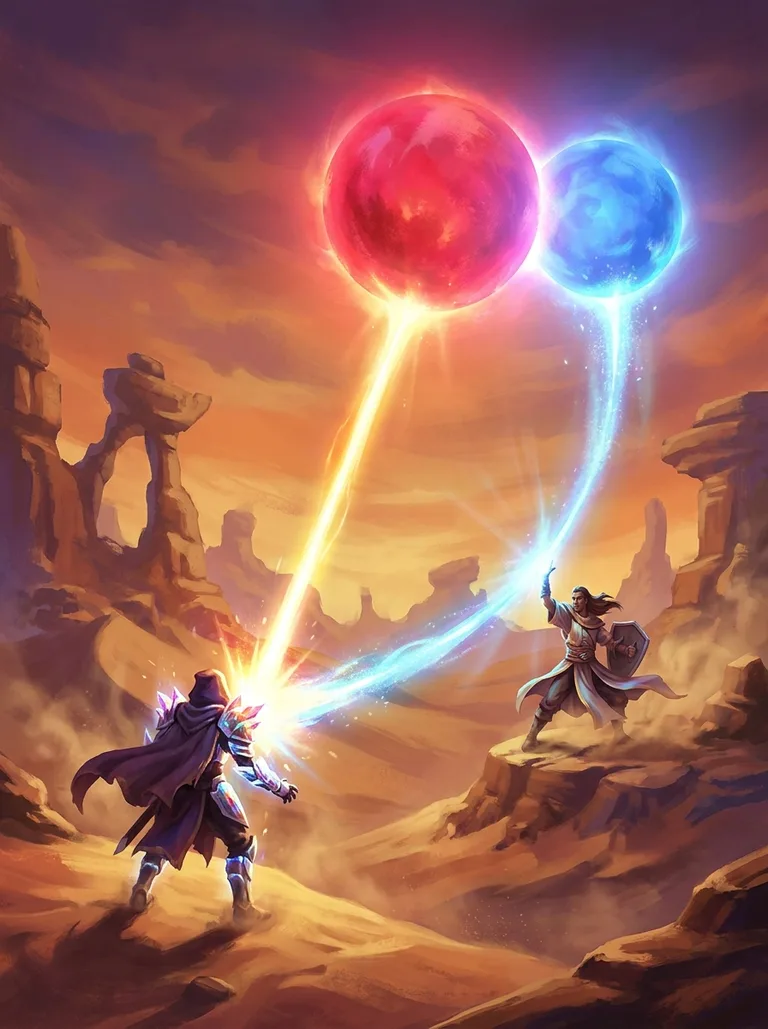
Two suns in the sky: one for you, one against you.
- Rarity
- Rare
- Category
- Trap
- Effect
- Reflects the attack damage back to your opponent.
The myth
Judgment of the Doubled Sun is a trap MYTHENOR created. There is no Egyptian myth of two suns in the sky. The image, however, speaks to the importance of the two horizons for the Egyptians: the east, where the sun was reborn each morning, and the west, where it died and entered the underworld, the land of the dead. Aker was the deified horizon, guardian of the eastern and western horizons of the afterlife. And the sun took different forms across the day. In the game, one sun is for you and another against the enemy.
Why it has this power
A rare reflection trap: when an opponent's monster attacks, all the breath damage you would take in that battle goes to the attacker's controller instead. It has the same effect as the Lapis Lazuli Mirror, at a higher rarity, reinforcing decks that punish attackers.
Did you know
Aker, the deified horizon, guarded both the eastern and the western horizons of the afterlife.
Connections
- In High Priest Khaymet's deck
- In Merytamun, the Last Sentinel's deck
Where to get it
- Daily Offering: 0.11% per pack (Rare 2.8% per card)
- Traveler's Pack: 0.69% per pack · 4.2% in the themed pack (Rare 7% per card)
- Bronze Reliquary: 0.78% per pack · 4.7% in the themed pack (Rare 8% per card)
- Silver Reliquary: 1.3% per pack · 7.9% in the themed pack (Rare 15% per card)
- Golden Reliquary: 2% per pack · 12% in the themed pack (Rare 25% per card)
- Daily Showcase: Shows up on about 1.5% of days · 400 gems
- Craft with card dust: 600 dust
- Crossing of Myths: Can be offered as a reward during a crossing (the card stays in the crossing deck).
Sources
- Egyptian Gods - The Complete List — Joshua J. Mark (World History Encyclopedia)
- Ra (Egyptian God) — Joshua J. Mark (World History Encyclopedia)