Egyptian · No. 095
Eye of the Sandstorm
Inspired by: The Eye of Horus, the udjat, symbol of the god's watchful presence over creation.
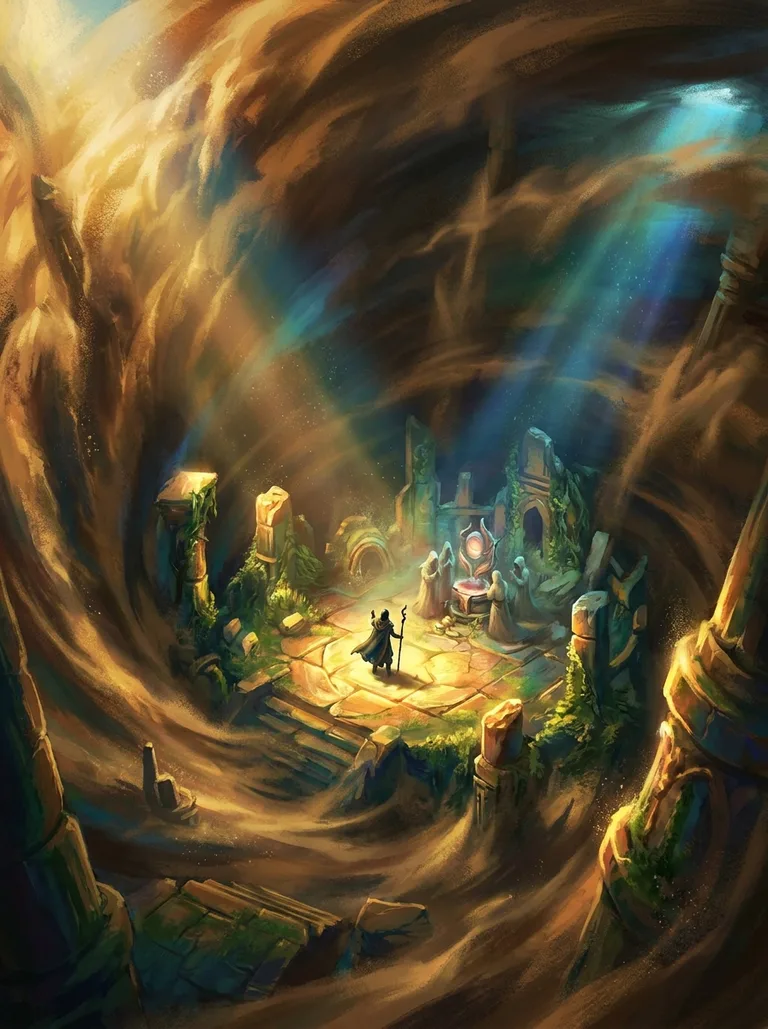
At the heart of the storm, the sand hides nothing.
- Rarity
- Common
- Category
- Spell
- Effect
- Flips your opponent's face-down monsters face-up.
The myth
Eye of the Sandstorm is a MYTHENOR spell inspired by one of Egypt's best-known symbols: the Eye of Horus, or udjat. In myth, Horus lost an eye fighting Set for the throne. The eye became a powerful amulet, worn by the living and the dead, and a symbol of the god's watchful presence over creation. Since the sun and moon were seen as Horus's two eyes, nothing escaped his gaze, by day or night. In the game, that gaze pierces the sand and reveals what was hidden.
Why it has this power
A common information spell: it reveals all of the opponent's face-down cards, monsters and traps alike. At the center of the storm, the sand hides nothing. Use it before attacking to learn which traps are waiting, or to pick the right target for your destruction spells.
Did you know
Horus was imagined as a falcon who could fly far from Ra and return with vital information.
Connections
- In Scribe Nefru's deck
- In Sethis, Novice Sentinel's deck
- In Captain Amunet's deck
Where to get it
- Daily Offering: 0% per pack (Common 64% per card)
- Welcome Pack: 0.97% per pack (Common 70% per card)
- Traveler's Pack: 0.88% per pack · 5.2% in the themed pack (Common 64% per card)
- Bronze Reliquary: 0.86% per pack · 5.1% in the themed pack (Common 62% per card)
- Silver Reliquary: 0.67% per pack · 4% in the themed pack (Common 49% per card)
- Golden Reliquary: 0.46% per pack · 2.7% in the themed pack (Common 33% per card)
- Daily Showcase: Shows up on about 0.69% of days · 150 gold
- Craft with card dust: 40 dust
- Crossing of Myths: Can be offered as a reward during a crossing (the card stays in the crossing deck).
Sources
- Ancient Egyptian Symbols — Joshua J. Mark (World History Encyclopedia)
- Horus — Joshua J. Mark (World History Encyclopedia)