Egyptian · No. 027
Bearer of the Royal Khopesh
Inspired by: The khopesh, the curved sickle-shaped sword used in Egypt from the Second Intermediate Period.
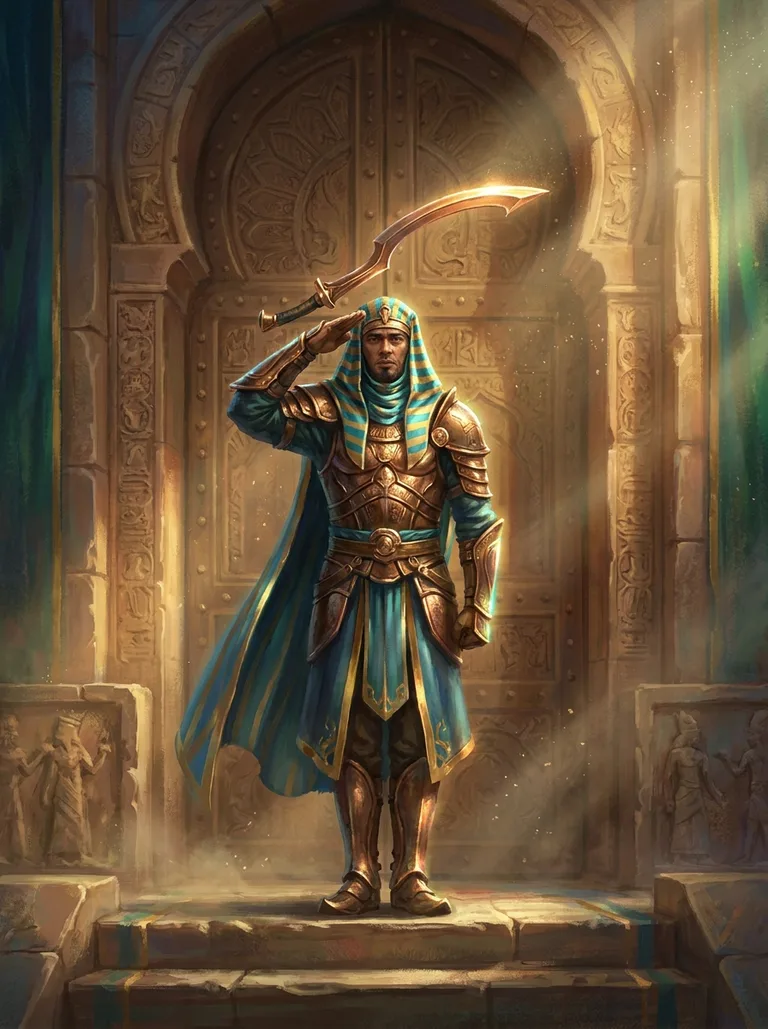
The curved blade belongs to the king. So does the arm that wields it.
- Rarity
- Common
- Category
- Monster
- ATK
- 1200
- DEF
- 1000
- Level
- 3
- Type
- Warrior
- Element
- Earth
- Constellations
- Feather · Hammer
The myth
The khopesh is a historical weapon, not a mythological one: a curved sword, shaped like a scimitar or sickle, which according to World History Encyclopedia reached Egypt with the Hyksos, along with the war chariot and the composite bow. The Egyptians later adapted it into a shorter sword. In New Kingdom imagery, weapons like this accompanied the warrior pharaoh, protector of order, ma'at, against chaos. The bearer on this card, wielding the king's blade, is a MYTHENOR figure.
Why it has this power
A common level 3 Warrior of Earth with 1200 ATK and 1000 DEF: strong for its level. Feather beats Sun and Hammer beats Bull. With the Ancient Bronze Khopesh equipment, which gives Warriors +500, the royal blade cuts like that of a level 5.
Did you know
According to World History Encyclopedia, the Egyptians adapted the Hyksos curved sword into a shorter model.
Connections
- In Scribe Nefru's deck
- In Sethis, Novice Sentinel's deck
- In Captain Amunet's deck
Where to get it
- Campaign drop: Sethis, Novice Sentinel (The Obsidian Necropolis) — grade C: 15% · grade D: 13%
- Daily Offering: 0% per pack (Common 64% per card)
- Welcome Pack: 0.97% per pack (Common 70% per card)
- Traveler's Pack: 0.88% per pack · 5.2% in the themed pack (Common 64% per card)
- Bronze Reliquary: 0.86% per pack · 5.1% in the themed pack (Common 62% per card)
- Silver Reliquary: 0.67% per pack · 4% in the themed pack (Common 49% per card)
- Golden Reliquary: 0.46% per pack · 2.7% in the themed pack (Common 33% per card)
- Daily Showcase: Shows up on about 0.69% of days · 150 gold
- Craft with card dust: 40 dust
- Crossing of Myths: Can be offered as a reward during a crossing (the card stays in the crossing deck).
Sources
- Ancient Egyptian Warfare — Joshua J. Mark (World History Encyclopedia)