Egyptian · No. 098
Wisdom of the Lost Scribes
Inspired by: The House of Life, Per-Ankh, the temple libraries, and Seshat, goddess of writing and patron of libraries.
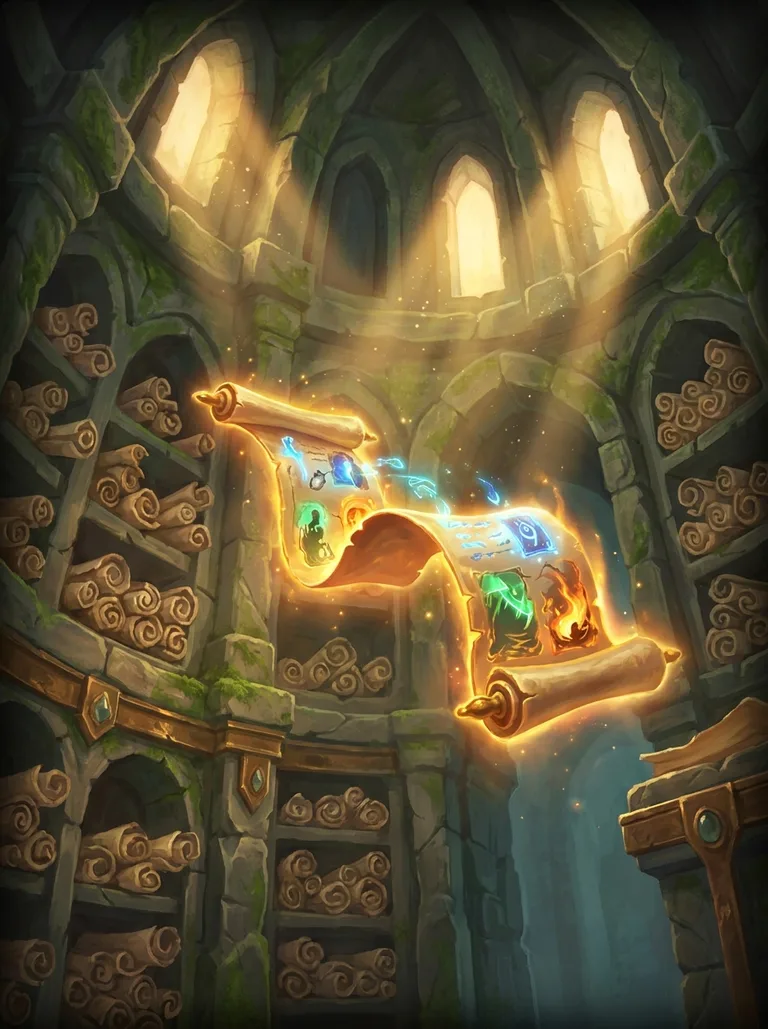
The answers were in scrolls no one read.
- Rarity
- Uncommon
- Category
- Spell
- Effect
- Draw 3 cards.
The myth
Egyptian temples kept papyrus scrolls in the House of Life, the Per-Ankh, which according to World History Encyclopedia combined library, scriptorium, institute of higher learning and writers' workshop. Its patron was Seshat, whose name means female scribe, shown with a leopard skin over her robe; she wrote the king's name on the leaves of the sacred tree, each leaf a year of his reign. Wisdom of the Lost Scribes, a MYTHENOR spell, recalls that the answers lay in the scrolls no one read.
Why it has this power
An uncommon draw spell: you draw 3 cards from your deck. It is pure knowledge, with no damage or boost, but three new cards in hand open the way to fusions, rituals and answers. It suits Spellcaster decks, the heirs of the scribes.
Did you know
Seshat also took part in the stretching of the cord rite, which marked out the ground before a temple was built.
Connections
- In Sethis, Novice Sentinel's deck
- In Captain Amunet's deck
- In Oracle Bakenra's deck
- In High Priest Khaymet's deck
- In Merytamun, the Last Sentinel's deck
Where to get it
- Daily Offering: 0.45% per pack (Uncommon 33% per card)
- Welcome Pack: 1.1% per pack (Uncommon 30% per card)
- Traveler's Pack: 0.96% per pack · 5.6% in the themed pack (Uncommon 29% per card)
- Bronze Reliquary: 0.94% per pack · 5.5% in the themed pack (Uncommon 29% per card)
- Silver Reliquary: 0.96% per pack · 5.6% in the themed pack (Uncommon 33% per card)
- Golden Reliquary: 0.94% per pack · 5.5% in the themed pack (Uncommon 35% per card)
- Daily Showcase: Shows up on about 0.98% of days · 400 gold
- Craft with card dust: 100 dust
- Crossing of Myths: Can be offered as a reward during a crossing (the card stays in the crossing deck).