Egyptian · No. 085
Plague Locust Swarm
Inspired by: The eighth plague of Egypt in the biblical book of Exodus; it is a Hebrew tradition, not an Egyptian myth.
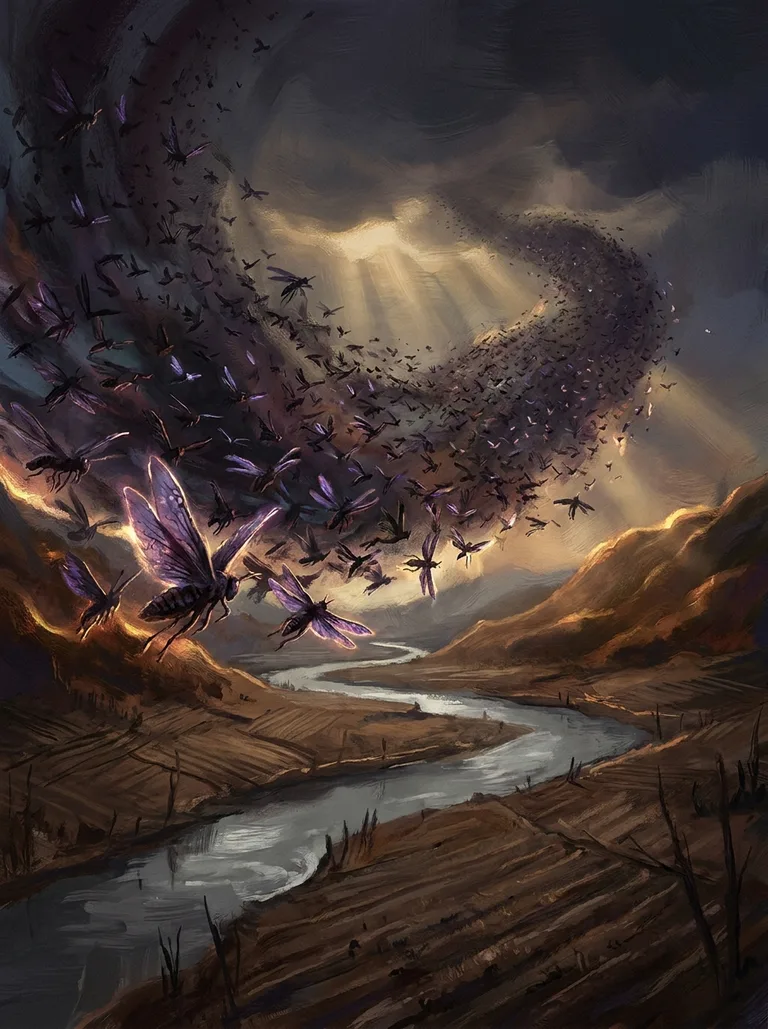
It darkens the sky at noon. It doesn't even leave the shadows.
- Rarity
- Uncommon
- Category
- Monster
- ATK
- 1700
- DEF
- 1000
- Level
- 5
- Type
- Insect-Plant
- Element
- Wind
- Constellations
- Feather · Scarab
The myth
This card does not come from Egyptian religion but from a tradition about Egypt. The ten plagues are told in chapters 7 to 12 of the book of Exodus, in the Hebrew Bible. The eighth plague was a cloud of locusts that would devour whatever the hail had left, even the trees in the fields. Historian Rebecca Denova, writing in World History Encyclopedia, notes that there is no archaeological evidence from Egypt in this period confirming the presence of the Hebrews. MYTHENOR uses the image as a force of nature in the desert.
Why it has this power
An uncommon level 5 Insect of Wind with 1700 ATK and only 1000 DEF: a swarm that attacks in mass and scatters easily. Feather beats Sun, like the cloud that darkens noon, and Scarab beats Leviathan. It hits hard for its level, but any trap will break it.
Did you know
Locust swarms are a real phenomenon in North Africa and the Middle East, capable of devastating entire crops.
Connections
- In Scribe Nefru's deck
- In Oracle Bakenra's deck
Where to get it
- Campaign drop: Scribe Nefru (The Obsidian Necropolis) — grade S: 20% · grade A: 17%
- Daily Offering: 0.45% per pack (Uncommon 33% per card)
- Welcome Pack: 1.1% per pack (Uncommon 30% per card)
- Traveler's Pack: 0.96% per pack · 5.6% in the themed pack (Uncommon 29% per card)
- Bronze Reliquary: 0.94% per pack · 5.5% in the themed pack (Uncommon 29% per card)
- Silver Reliquary: 0.96% per pack · 5.6% in the themed pack (Uncommon 33% per card)
- Golden Reliquary: 0.94% per pack · 5.5% in the themed pack (Uncommon 35% per card)
- Daily Showcase: Shows up on about 0.98% of days · 400 gold
- Craft with card dust: 100 dust
- Crossing of Myths: Can be offered as a reward during a crossing (the card stays in the crossing deck).
Sources
- Ten Plagues of Egypt — Rebecca Denova (World History Encyclopedia)