Egyptian · No. 018
Temple Fire-Swallow
Inspired by: The transformation chapters of the Book of the Dead, which let the deceased take the form of a swallow.
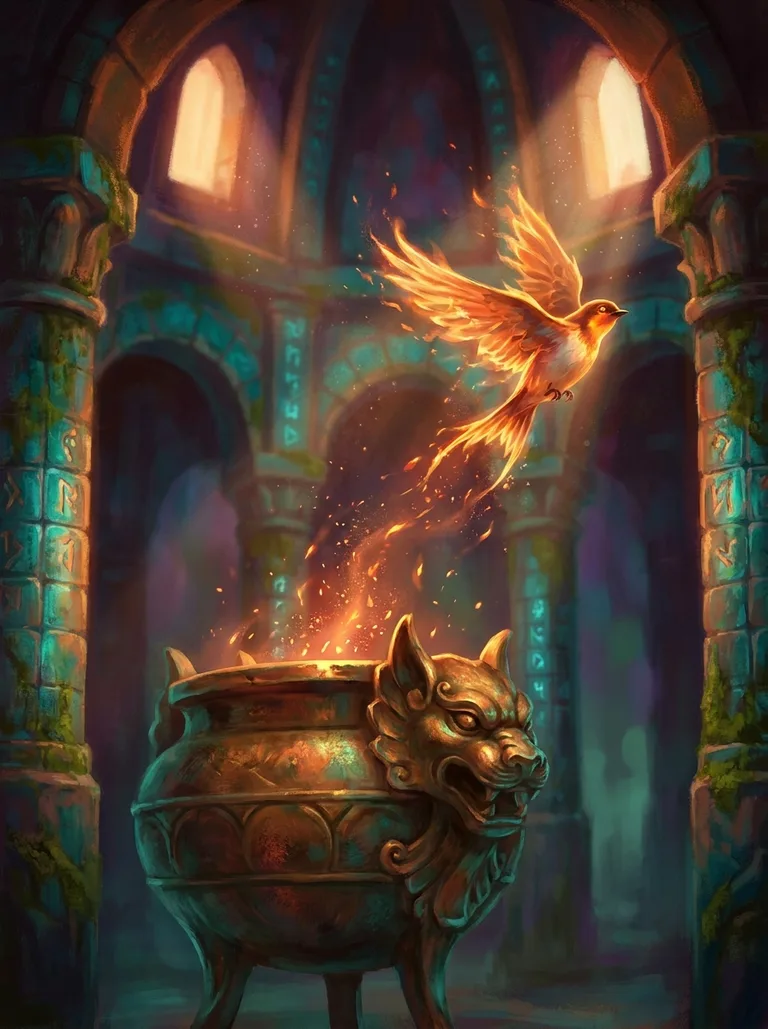
It lives in the temple braziers and never burns its wings.
- Rarity
- Common
- Category
- Monster
- ATK
- 800
- DEF
- 600
- Level
- 2
- Type
- Bird
- Element
- Fire
- Constellations
- Feather · Crown
The myth
In the Book of the Dead, a group of chapters called the Transformations let the deceased take on, at will, forms such as the golden hawk, the pure lily, the Benu bird, the heron, the soul of Ra, the earth serpent, the crocodile and the swallow. In this way they could move freely between worlds. The swallow, small and swift, was one of the forms sought. The temple braziers where this bird lives without ever burning its wings are a MYTHENOR image, linking it to Bennu's nest of fire.
Why it has this power
A common level 2 Bird of Fire with 800 ATK and 600 DEF: too small to fight alone. Feather beats Sun and Crown beats Scarab. Its worth lies in the Rite of the Myrrh Nest: with the Spirit of the Turquoise Flame and the Glass-Sand Wyrm, it calls Bennu.
Did you know
In the Book of the Dead's list of transformations, the swallow and the Benu bird appear side by side, just as in this card and its ritual.
Connections
- In Captain Amunet's deck
- In Oracle Bakenra's deck
Where to get it
- Daily Offering: 0% per pack (Common 64% per card)
- Welcome Pack: 0.97% per pack (Common 70% per card)
- Traveler's Pack: 0.88% per pack · 5.2% in the themed pack (Common 64% per card)
- Bronze Reliquary: 0.86% per pack · 5.1% in the themed pack (Common 62% per card)
- Silver Reliquary: 0.67% per pack · 4% in the themed pack (Common 49% per card)
- Golden Reliquary: 0.46% per pack · 2.7% in the themed pack (Common 33% per card)
- Daily Showcase: Shows up on about 0.69% of days · 150 gold
- Craft with card dust: 40 dust
- Crossing of Myths: Can be offered as a reward during a crossing (the card stays in the crossing deck).
Sources
- The Book of the Dead (introduction and chapter summaries) — E. A. Wallis Budge (Project Gutenberg)
- Egyptian Book of the Dead — Joshua J. Mark (World History Encyclopedia)