The MYTHENOR encyclopedia
Norse Mythology
Who they were
Norse mythology is the body of beliefs and stories of the Scandinavian peoples before Christianization, which was complete around the year 1000 in Iceland and somewhat later in Norway and Sweden. It was part of a wider Germanic religion with no holy book or central church, lived out through sacrifices, seasonal feasts, oaths and oral poetry. Nearly everything we know comes from texts written in Christian Iceland in the thirteenth and fourteenth centuries: the Poetic Edda, a collection of older poems preserved in the Codex Regius, and the Prose Edda, a handbook of poetry by Snorri Sturluson, along with the sagas and the verses of the skalds. Runestones, amulets and graves complete the picture. It is a harsh and poetic world of long winters and dangerous seas, where honor, one's given word, hospitality and fame after death count for more than life itself, and where even the gods know that one day they will fall.
Cosmology
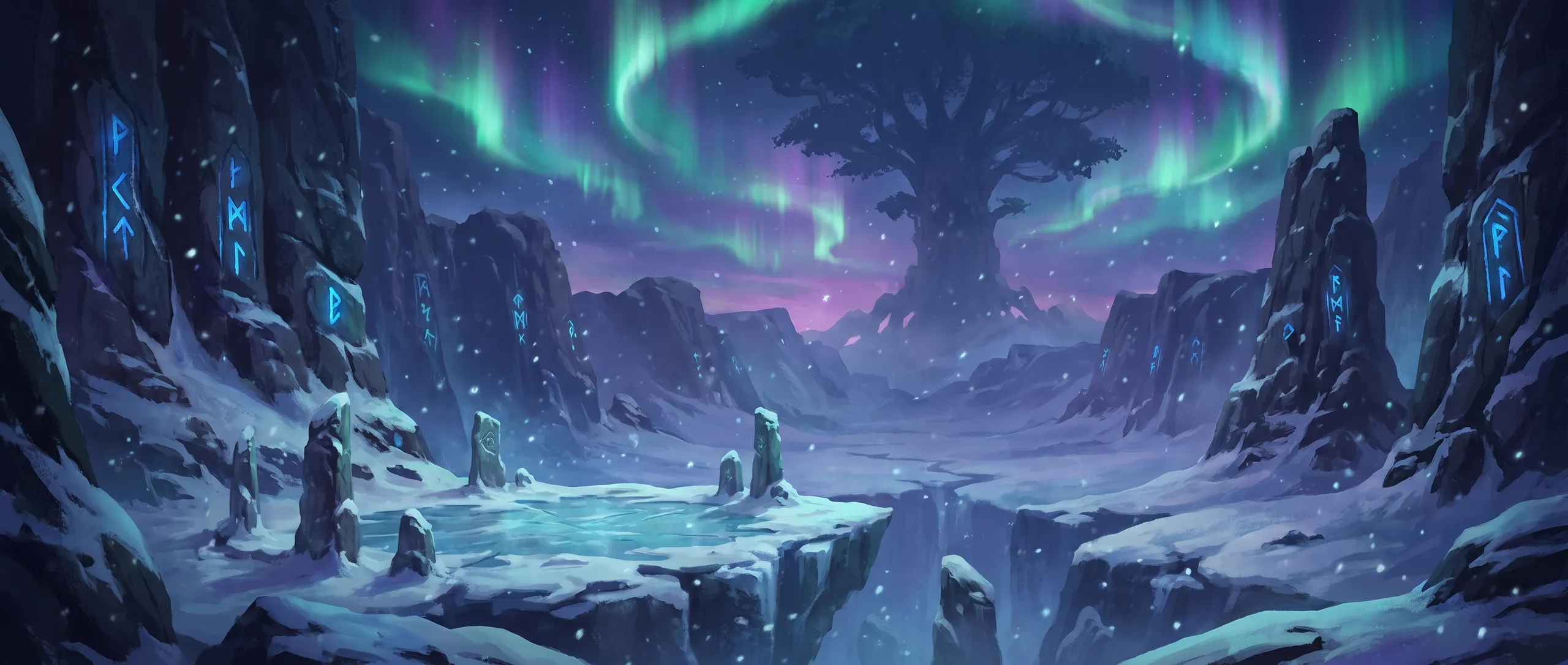
In the beginning there was Ginnungagap, an empty chasm between Niflheim, the icy world of mist, and Muspelheim, the world of fire. Where rime met heat, the drops gave life to the giant Ymir and the cow Auðumbla. Odin and his brothers killed Ymir and made the world from his body: the earth from his flesh, the sea from his blood, the sky from his skull. At the center of the cosmos grows Yggdrasil, the ash whose branches spread over the nine worlds, among them Asgard of the gods, Midgard of humans and Jötunheimr of the giants. Beneath its roots lie the wells of Urðr and Mímir, and the Norns spin fate. The dead go to Valhöll or Fólkvangr if they fell in battle, or to the realm of Hel. Time ends at Ragnarök: after a three-year winter, gods and giants destroy one another and Surtr's fire burns everything. But a green earth rises again from the sea, and a few gods and a human pair begin the world anew.
Pantheon
The Norse gods form two families. The Æsir, who live in Asgard, are led by Odin, the All-Father, god of wisdom, poetry, magic and the battle-slain, and by his wife Frigg. Thor, the thunder god, protects gods and humans from the giants with the hammer Mjölnir. Týr is the god of law and courage, Heimdall guards the bridge Bifröst, and Baldr is the most beloved, whose death foretells the end. The Vanir, linked to fertility and prosperity, include Njörðr, god of the sea, and his children Freyr, lord of the harvest, and Freyja, goddess of love, magic and war. After an ancient war, the two families made peace. Loki, a giant's son, lives among the gods as both ally and threat, father of Fenrir, the Midgard Serpent and Hel.
In MYTHENOR
In MYTHENOR this is the land of the Yggdrasil Fjord, beneath the Aurora Sky, raised with sagas told around the fire through the long winter nights. At the root of the great tree, the guardian Freydís protects the aurora thread. Kaelmyr's silence has already arrived: the aurora fades, the ravens forget their way home and a rune stone has woken up blank. The player faces the duelists Björn, Ingrid, Sigrun, Thorvald and Halvard, and Úlfar Redstorm, the thunder rookie, hails from the Anvil Village. In the Travessia, Freydís's echo has become the Fimbulvetr.
A note on respect
Norse myths are not only the past: Ásatrú, a religion honoring the old gods, is practiced today and was officially recognized in Iceland in 1973. It is also worth remembering that Norse symbols such as runes and Thor's hammer are sometimes appropriated by extremist groups. MYTHENOR rejects that use and treats these stories as shared cultural heritage, told with care and curiosity.
Sources
- Norse Mythology — Emma Groeneveld
- Germanic religion and mythology — Encyclopaedia Britannica
- Edda — Encyclopaedia Britannica
- Snorri Sturluson — Encyclopaedia Britannica
- The Poetic Edda — Henry Adams Bellows (trad./trans.)
- The Prose Edda (Project Gutenberg) — Arthur Gilchrist Brodeur (trad./trans.)
The 120 cards
- Jörmungandr, World Serpent
- Odin, All-Father
- Fenrir, Devourer of the Sun
- Thor, Lord of Thunder
- Muspelheim Ember Wyrm
- Niflheim Rime Drake
- Howling-Peak Storm Drake
- Aurora-Veil Dragon
- Surtr's Soot Wyrm
- Thunder-Rune Dragon
- Níðhöggr, Gnawer of Roots
- Fáfnir, Warden of the Cursed Hoard
- Frosttide Serpent
- Bearhide Berserker
- Blackfjord Serpent
- Northgale Serpent
- Marsh Lindworm
- Skaði's Venom Serpent
- Daughter of Jörmungandr
- Huginn, Thought
- Muninn, Memory
- Fjalar, the Crimson Rooster
- Thrudvangr Thunderhawk
- Gullinkambi, the Gold-Combed Rooster
- Hræsvelgr, Corpse-Swallower
- All-Seeing Raven of Hliðskjálf
- Regin, the Bitter Smith
- Ember Raider
- Valkyrie of Vigrid
- Muspell Flame-Warrior
- Sigurd the Dragonslayer
- Brynhildr in the Ring of Fire
- Sigurd Fáfnisbani, Dragon-Blood Taster
- Hrungnir, the Stone-Hearted
- Geri, the Ravenous Wolf
- Freki, the Greedy Wolf
- Tanngrisnir, the Thunder Goat
- Ratatoskr, the Messenger Squirrel
- Auðumbla, the Primordial Cow
- Gullinbursti, the Golden Boar
- Svaðilfari, the Mason's Stallion
- Garmr, Hound of Hel's Gate
- Wolves of the High Seat
- Sleipnir, the Eight-Legged Steed
- Wolf-Coat Úlfheðinn
- Boar-Helm Raider
- Marmennill, the Prophet Merman
- Hrólfr's Bear-Guard
- Wolf-Jarl of Járnviðr
- Bǫðvarr Bjarki, the Battle-Bear
- Fylgja, the Guardian Fetch
- Mountain Landvættr
- Pinewood Huldra
- Ancestral Dís
- Nøkken, Singer of the Falls
- Light-Elf of Álfheimr
- Iðunn of the Golden Apples
- Freyr, Lord of the Harvest
- Baldr the Beautiful
- Heimdall, Watcher of Bifröst
- Heimdall Sounds the Gjallarhorn
- Frozen-Crypt Draugr
- Naglfar Oarsman
- Helhest, the Three-Legged Horse
- Mara, the Nightmare Rider
- Móðguðr, Warden of Gjallarbrú
- Draugr Jarl of Náströnd
- Naglfar, the Ship of Nails
- Fallen Baldr, the Light That Returns
- Iron-Staff Völva
- Rune-Carver of Uppsala
- Mist Seiðkona
- Rune-Master of Álfheimr
- Gullveig, Thrice-Burned
- Loki the Trickster
- The Norns of Urðr's Well
- Living Dwarven Forge-Bellows
- Svartálfaheimr Rune Automaton
- Brokkr's Forge Colossus
- Mökkurkálfi, the Clay Giant
- Skíðblaðnir, the Folding Ship
- Thor's Thundering Chariot
- Sharpened Mistletoe Sprout
- Yggdrasil Bark-Beetle
- Living Root of Yggdrasil
- Iðunn's Golden Apple Tree
- Surtr, Bearer of the Flaming Sword
- Hel, Queen of the Inglorious Dead
- Ymir, the Primordial Giant
- Yggdrasil Awakened
- Iðunn's Apples
- Sparks of Muspelheim
- Mead of the Einherjar
- Howl of Járnviðr
- Odin's Pledged Eye
- Breath of Fimbulwinter
- Gleipnir, the Silken Fetter
- Mead of Poetry
- Loki's Shapeshift
- Seiðr Binding
- Mjölnir Hurled
- Ragnarök's Fury
- Shield Wall
- Treacherous Fjord Ice
- Einherjar Ambush
- Svalinn, the Shield Before the Sun
- Niflheim Mist
- Rán's Drowning Net
- Andvari's Curse
- Thor's Reprisal
- Runic Bearded Axe
- Wolf-Fang Torc
- Megingjörð, the Belt of Strength
- Seiðr Staff
- Gram, the Reforged Sword
- The Halls of Valhöll
- Rite of Muspell's Flames
- Rite of the Gjallar Bridge
- Rite of Ginnungagap
- Rite of the Nine Roots