Norse · No. 084
Yggdrasil Bark-Beetle
Inspired by: The creatures that gnaw and bite Yggdrasil, described in Grímnismál.
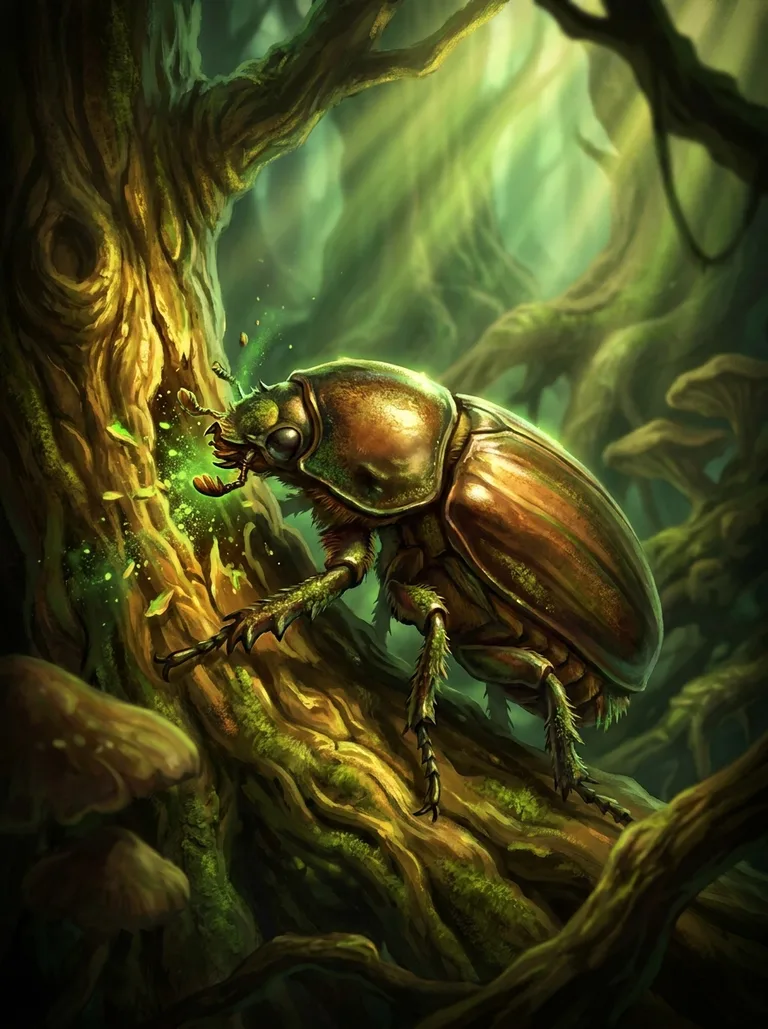
Too small to be noticed. Too patient to be stopped.
- Rarity
- Common
- Category
- Monster
- ATK
- 700
- DEF
- 900
- Level
- 3
- Type
- Insect-Plant
- Element
- Earth
- Constellations
- Sun · Scarab
The myth
Yggdrasil, the world tree, is no peaceful place. Grímnismál says it suffers more than men know: a hart bites from above, its side rots, and Níðhöggr gnaws from below. The same poem lists four harts that eat its shoots and many serpents beneath its roots. The Norns water it every day so that it will not rot. The texts mention no beetles. The Bark-Beetle is a MYTHENOR creation that joins this little army of the tree's patient gnawers.
Why it has this power
A level 3 Common with ATK 700 and DEF 900: too small to be noticed. An Earth Insect-Plant, under Sun and Scarab. Its role is in the Rite of the Nine Roots: with Ratatoskr and the Living Root, it awakens Yggdrasil. Those who live in the tree wake it.
Did you know
Yggdrasil's four harts are named in Grímnismál: Dáinn, Dvalinn, Duneyrr and Duraþrór.
Connections
- In Björn Greenshield's deck
- In Ingrid Icehunter's deck
- In Sigrun Runedaughter's deck
Where to get it
- Campaign drop: Sigrun Runedaughter (Yggdrasil Fjord) — grade D: 15%
- Daily Offering: 0% per pack (Common 64% per card)
- Welcome Pack: 0.97% per pack (Common 70% per card)
- Traveler's Pack: 0.88% per pack · 5.2% in the themed pack (Common 64% per card)
- Bronze Reliquary: 0.86% per pack · 5.1% in the themed pack (Common 62% per card)
- Silver Reliquary: 0.67% per pack · 4% in the themed pack (Common 49% per card)
- Golden Reliquary: 0.46% per pack · 2.7% in the themed pack (Common 33% per card)
- Daily Showcase: Shows up on about 0.69% of days · 150 gold
- Craft with card dust: 40 dust
- Crossing of Myths: Can be offered as a reward during a crossing (the card stays in the crossing deck).
Sources
- The Poetic Edda: Grimnismol — Henry Adams Bellows (trad./trans.)
- Yggdrasill — Encyclopaedia Britannica