Norse · No. 057
Iðunn of the Golden Apples
Real myth
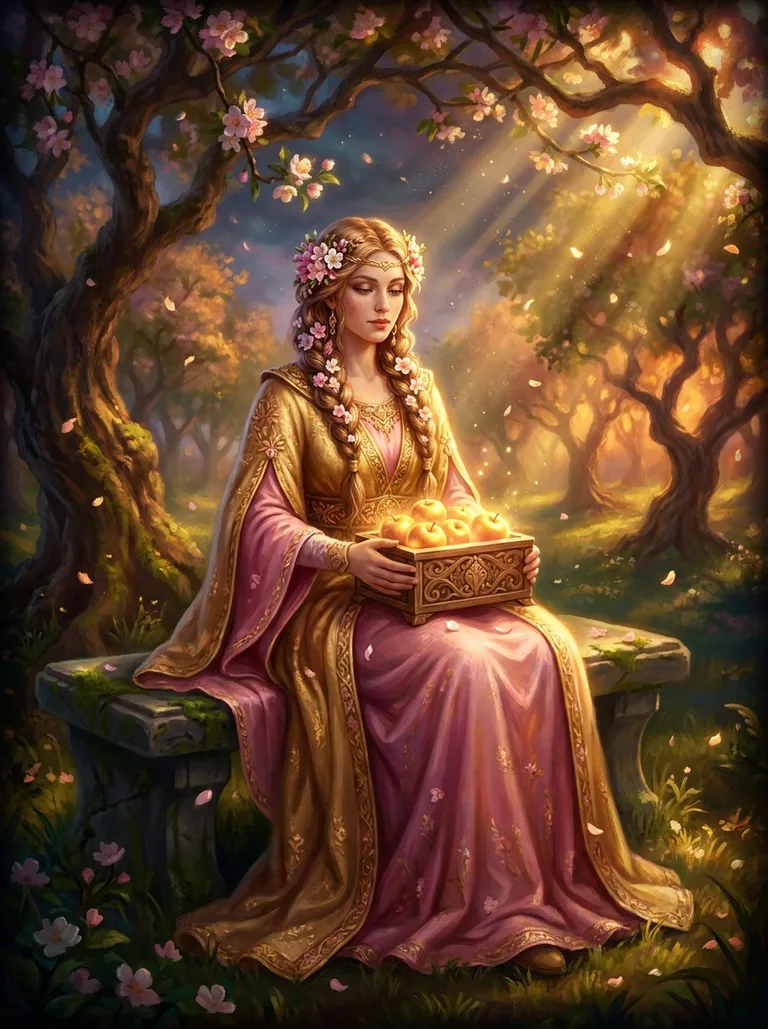
Without her apples, even gods grow old.
- Rarity
- Uncommon
- Category
- Monster
- ATK
- 1600
- DEF
- 1800
- Level
- 5
- Type
- Deity
- Element
- Light
- Constellations
- Sun · Crown
The myth
Iðunn, the renewing one, is the goddess who keeps the apples of youth in a box of ash wood. The gods eat them so as not to grow old. In Skáldskaparmál the giant Þjazi, in eagle form, forces Loki to lure Iðunn outside Asgard and abducts her. Without the apples, the gods grow old and grey. Under threat, Loki borrows Freyja's falcon cloak, turns Iðunn into a nut and brings her home; Þjazi pursues him and is burned at the walls. Iðunn is married to Bragi, god of poetry.
Why it has this power
A level 5 Uncommon with ATK 1600 and DEF 1800: eternal youth protects more than it wounds. Light element, under Sun and Crown, the constellations of Asgard's gods. As a Deity she wears the Belt of Strength. She pairs with Iðunn's Apples, which restore 800 breath.
Did you know
As compensation to Þjazi's daughter Skaði, Odin cast the giant's eyes into the sky, where they became stars.
Connections
- In Sigrun Runedaughter's deck
- In Freydís, Warden of Yggdrasil's deck
- In Kaelmyr, Devourer of Pantheons's deck
Where to get it
- Daily Offering: 0.45% per pack (Uncommon 33% per card)
- Welcome Pack: 1.1% per pack (Uncommon 30% per card)
- Traveler's Pack: 0.96% per pack · 5.6% in the themed pack (Uncommon 29% per card)
- Bronze Reliquary: 0.94% per pack · 5.5% in the themed pack (Uncommon 29% per card)
- Silver Reliquary: 0.96% per pack · 5.6% in the themed pack (Uncommon 33% per card)
- Golden Reliquary: 0.94% per pack · 5.5% in the themed pack (Uncommon 35% per card)
- Daily Showcase: Shows up on about 0.98% of days · 400 gold
- Craft with card dust: 100 dust
- Crossing of Myths: Can be offered as a reward during a crossing (the card stays in the crossing deck).
Sources
- Idun — Encyclopaedia Britannica
- Idunn — Joshua J. Mark
- Idunn – norrøn mytologi — Store norske leksikon