Norse · No. 093
Mead of the Einherjar
Real myth
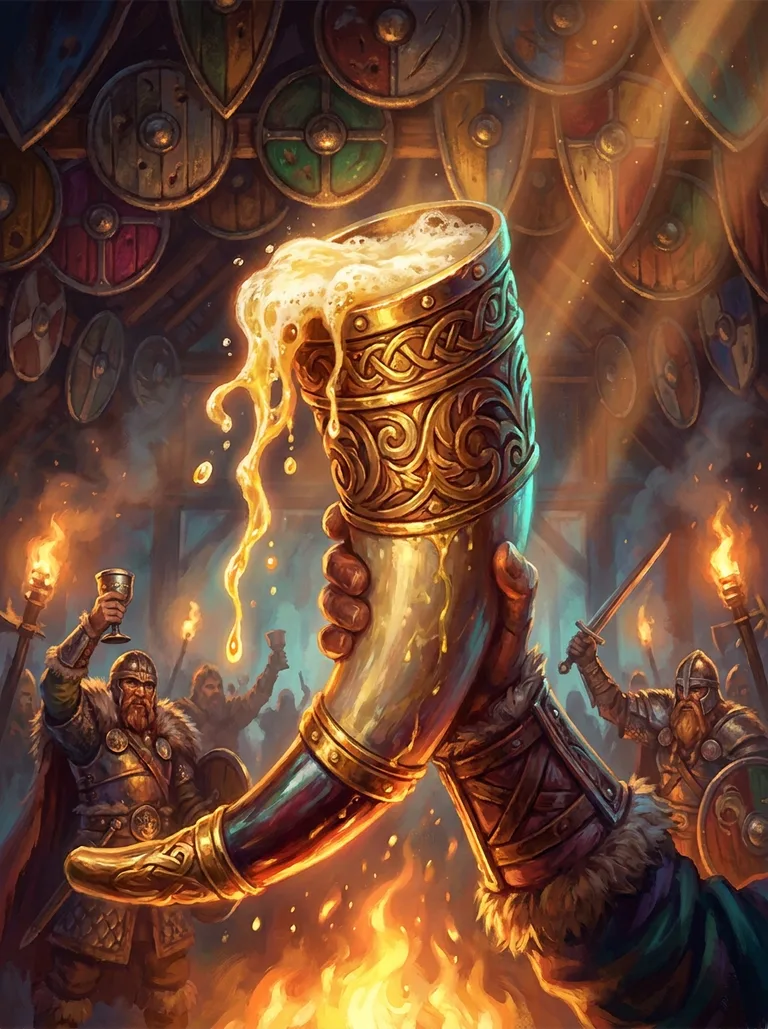
Drunk from a horn, poured out as courage.
- Rarity
- Common
- Category
- Spell
- Effect
- Your Warrior monsters gain +600 ATK and DEF.
The myth
The einherjar are the warriors slain in battle who go to Valhöll, Odin's hall. By day they go out to fight each other; at night, healed, they return to the hall to eat and drink, awaiting Ragnarök. Grímnismál and Snorri explain where the drink comes from: the goat Heiðrún stands on the roof of Valhöll eating the leaves of the tree Læraðr, and from her udder flows enough mead to fill a vat each day from which all the einherjar drink their fill. The valkyries serve it in horns.
Why it has this power
A Common spell that grants 600 ATK and DEF to all your Warriors while they remain on the field. It is courage drunk from a horn, as the card says. In the fjord, full of warriors from Sigurd to Surtr, it is one of the most valuable spells.
Did you know
Einherjar means something like those who fight alone, or those who form a single army.
Connections
- In Björn Greenshield's deck
- In Ingrid Icehunter's deck
- In Halvard the Grey Raven's deck
- In Freydís, Warden of Yggdrasil's deck
- In Kaelmyr, Devourer of Pantheons's deck
Where to get it
- Comes in every duelist's starter deck.
- Daily Offering: 0% per pack (Common 64% per card)
- Welcome Pack: 0.97% per pack (Common 70% per card)
- Traveler's Pack: 0.88% per pack · 5.2% in the themed pack (Common 64% per card)
- Bronze Reliquary: 0.86% per pack · 5.1% in the themed pack (Common 62% per card)
- Silver Reliquary: 0.67% per pack · 4% in the themed pack (Common 49% per card)
- Golden Reliquary: 0.46% per pack · 2.7% in the themed pack (Common 33% per card)
- Daily Showcase: Shows up on about 0.69% of days · 150 gold
- Craft with card dust: 40 dust
- Crossing of Myths: Can be offered as a reward during a crossing (the card stays in the crossing deck).
Sources
- einherjer — Store norske leksikon
- The Poetic Edda: Grimnismol — Henry Adams Bellows (trad./trans.)
- The Prose Edda: Gylfaginning — Arthur Gilchrist Brodeur (trad./trans.)