Norse · No. 111
Runic Bearded Axe
Inspired by: The Viking Age bearded axe and the victory runes that Sigrdrífumál says to carve on weapons.
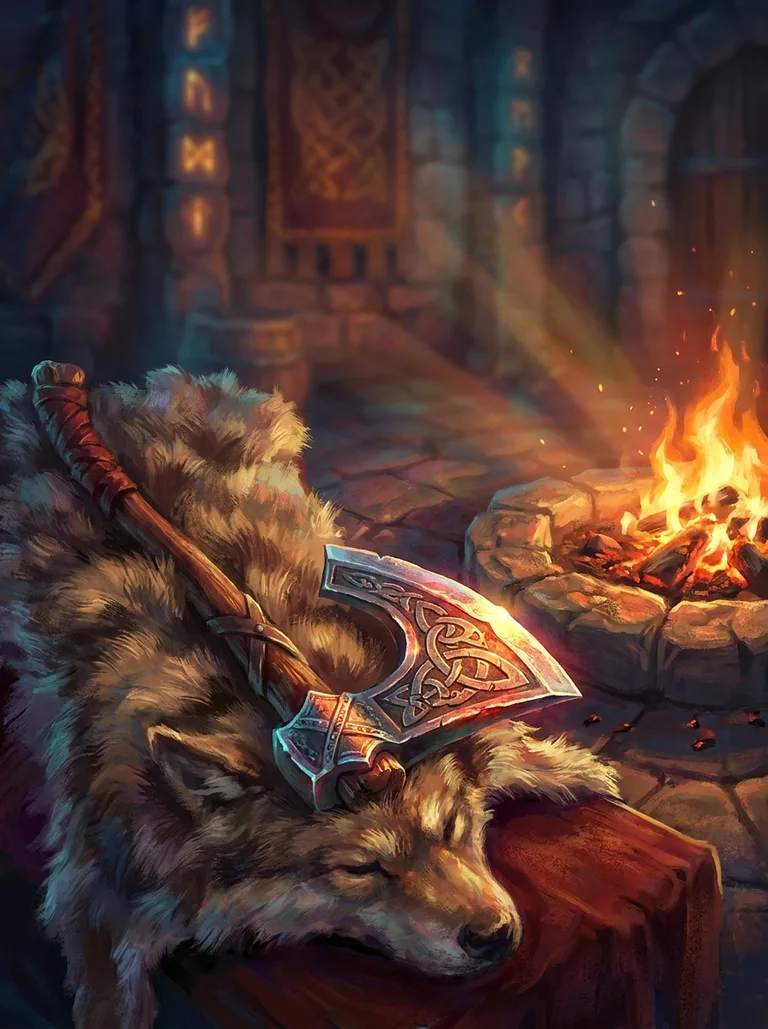
The edge is for the enemy. The runes are for fate.
- Rarity
- Common
- Category
- Equipment
- Effect
- Equip to a Warrior / Beast-Warrior monster: +500 ATK and DEF.
The myth
The bearded axe, skeggöx, had a blade extending downward, the beard, which let a fighter hook shields and grip the haft close to the iron. It was a common Viking Age weapon, and some examples were works of art, like the silver-inlaid Mammen axe from Denmark. In the poems, runes also protected weapons: in Sigrdrífumál the valkyrie teaches Sigurd to carve victory runes on his sword hilt and to call twice on Týr. A runic bearded axe is a MYTHENOR creation joining the two.
Why it has this power
A Common equipment that grants 500 ATK and DEF to a Warrior or Beast-Warrior. The edge is for the enemy, the runes are for fate, the card says. In a fjord full of warriors and beast-men, it is a cheap boost that turns commons into threats.
Did you know
The Mammen axe gave its name to a whole style of Viking art, the tenth-century Mammen style.
Connections
- In Björn Greenshield's deck
- In Ingrid Icehunter's deck
- In Thorvald Blackkeel's deck
- In Halvard the Grey Raven's deck
Where to get it
- Comes in every duelist's starter deck.
- Daily Offering: 0% per pack (Common 64% per card)
- Welcome Pack: 0.97% per pack (Common 70% per card)
- Traveler's Pack: 0.88% per pack · 5.2% in the themed pack (Common 64% per card)
- Bronze Reliquary: 0.86% per pack · 5.1% in the themed pack (Common 62% per card)
- Silver Reliquary: 0.67% per pack · 4% in the themed pack (Common 49% per card)
- Golden Reliquary: 0.46% per pack · 2.7% in the themed pack (Common 33% per card)
- Daily Showcase: Shows up on about 0.69% of days · 150 gold
- Craft with card dust: 40 dust
- Crossing of Myths: Can be offered as a reward during a crossing (the card stays in the crossing deck).
Sources
- The Poetic Edda: Sigrdrifumol — Henry Adams Bellows (trad./trans.)
- Viking — Encyclopaedia Britannica