The MYTHENOR encyclopedia
Greek Mythology
Who they were
Greek mythology is the body of stories about gods, heroes and monsters told by the Greek-speaking peoples of the Aegean islands and coasts, Asia Minor and the colonies of the Mediterranean. Its roots reach back to the Bronze Age, and the earliest great surviving texts are the Iliad and the Odyssey, attributed to Homer, and Hesiod's Theogony and Works and Days, composed around the eighth and seventh centuries BCE. The myths were sung by bards, staged in the theater of Athens, painted on vases and carved on temples. For the Greeks, the gods had human form and human emotions, and the world was full of divine forces: rivers, mountains and trees each had their nymphs. The heroic ideal was glory, kleos, the fame that let a name outlive death for as long as it was sung.
Cosmology
According to Hesiod's Theogony, in the beginning came Chaos, the yawning void, and then Gaia, Earth, Tartarus in the depths, and Eros. Gaia bore Uranus, Sky, and from the two came the Titans, the Cyclopes and the Hundred-Handers. The Titan Cronus overthrew his father and, fearing the same fate, swallowed his children, until Rhea saved Zeus. Zeus freed his siblings, defeated the Titans in a ten-year war, the Titanomachy, and imprisoned them in Tartarus; later he defeated the monster Typhon. The three brothers divided the world: Zeus took the sky, Poseidon the sea and Hades the realm of the dead. Souls went down to Hades as shades, crossing the river with the ferryman Charon; a few heroes reached the Elysian Fields, and great sinners were punished in Tartarus.
Pantheon
Atop Olympus reigned the twelve great gods, in a list that varied slightly. Zeus was king, lord of the sky and the thunderbolt, guardian of justice; Hera, his wife, protected marriage. Poseidon ruled the sea and earthquakes. Athena was goddess of wisdom and strategy; Apollo of light, music and oracles; Artemis, his twin, of the hunt. Aphrodite was goddess of love, Ares god of brutal war, Hephaestus the smith, Hermes the messenger, Demeter goddess of the harvest, and Hestia or Dionysus completed the group. Hades ruled beneath the earth. Around them lived Titans, nymphs, Muses, spirits such as the Keres and Nemesis, and the heroes, children of gods and mortals.
In MYTHENOR
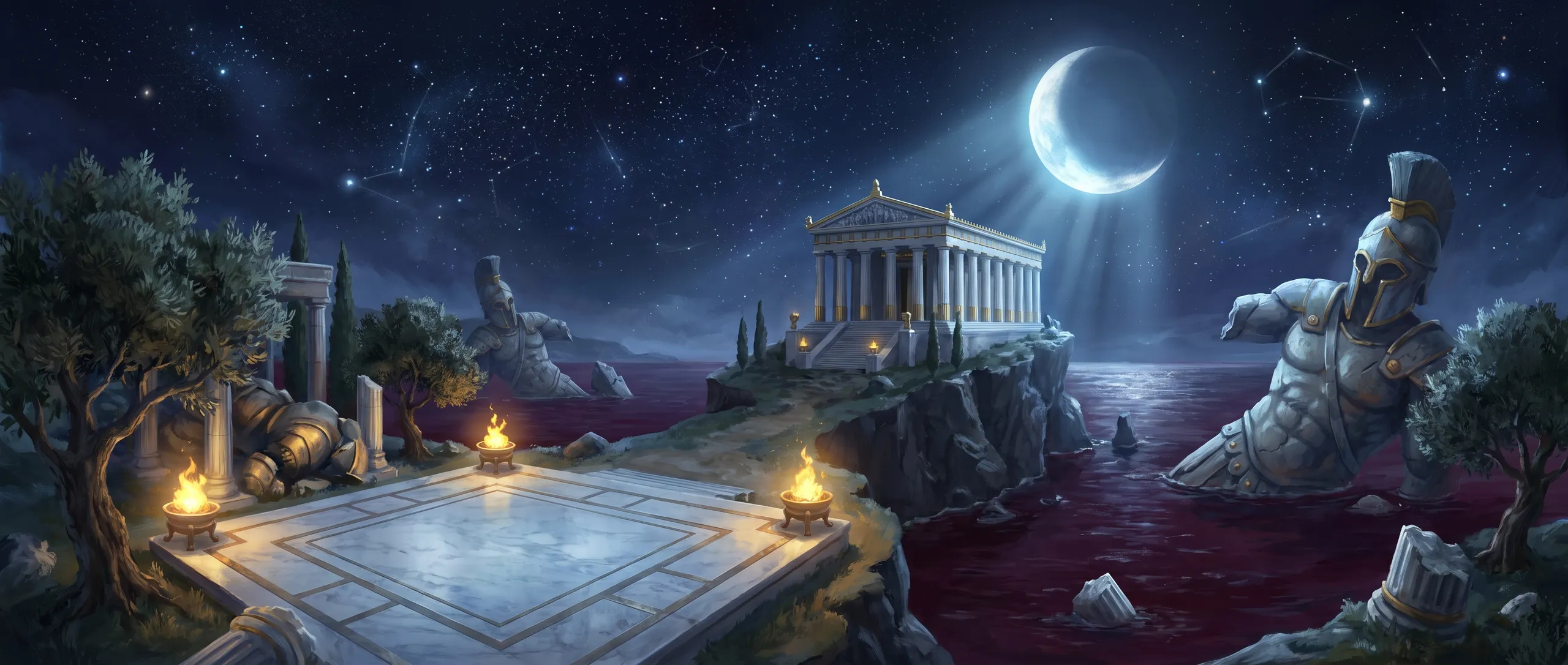
In MYTHENOR, Greek mythology is the Aegean of Heroes, under the Bronze Sky, woven from the epics bards sang from port to port. There, to be remembered is to live: glory is a form of immortality. The Champion Aristeia guards the bronze thread in a temple on the cliff. But for three moons Olympus has not answered, the oracles see only smoke, the strait of Scylla and Charybdis has grown too calm, and souls arrive in the underworld without names. Ione of Aegina is the playable heroine of this land.
Sources
- Greek Mythology (World History Encyclopedia) — Mark Cartwright
- Theogony (World History Encyclopedia) — Donald L. Wasson
- Theogony — Hesiod (trans. H. G. Evelyn-White), Theoi Classical Texts Library
- Ancient Greek Religion (World History Encyclopedia) — Mark Cartwright
- Iliad (World History Encyclopedia) — Mark Cartwright
The 120 cards
- Medusa, Gorgon of Stone
- Zeus, Lord of Olympus
- Lernaean Hydra, the Regenerator
- Achilles, the Unyielding Hero
- Etna Drakon Hatchling
- Aeolian Storm Drakon
- Golden Drakon of Rhodes
- Sleepless Drakon of Colchis
- Dragon of Ares's Spring
- Ladon, Guardian of the Hesperides
- Medea's Winged Dragons
- Python, the Oracular Serpent
- Libyan Asp
- Winged Serpent of Boreas
- Charybdis, the Throat of the Sea
- Six-Necked Scylla
- Euryale, the Undying Gorgon
- Scylla and Charybdis, the Deadly Strait
- Owl of Athena
- Aello, the Storm Harpy
- Minotaur of the Labyrinth
- Stymphalian Bird
- Siren of Anthemoessa
- Eagle of Zeus
- Pegasus, the Winged Horse
- Icarus, Wings of Wax
- Young Spartan Hoplite
- Keeper of Hestia's Flame
- Hoplite of Ares
- Theseus of Athens
- Jason the Argonaut
- Bellerophon
- Perseus, Gorgon-Slayer
- Young Heracles
- Peleus the Wrestler
- Arges, the Thunderbolt Cyclops
- Heracles, Clad in the Lion
- Theseus, Victor of the Labyrinth
- The Argonauts Aboard the Argo
- Ceryneian Hind
- Lycian Lion
- Mares of Diomedes
- Erymanthian Boar
- Cretan Bull
- Nemean Lion
- Chimera of Lycia
- Thessalian Plains Centaur
- Satyr Piper
- Drunken Feast Centaur
- Triton, Herald of the Waves
- Chiron, the Wise Centaur
- Bellerophon Astride Pegasus
- Dryad of the Dodona Oak
- Naiad of the Castalian Spring
- Oread of the Peaks
- Calliope, Muse of Epic Poetry
- The Keres, Spirits of Violent Death
- Hestia, Keeper of the Hearth
- Eos, Rosy-Fingered Dawn
- Helios, Driver of the Sun
- Thetis, the Silver-Footed Nereid
- Poseidon, Earth-Shaker
- Hades, Lord of the Dead
- Pan, Lord of the Wild
- Thanatos, the Gentle Death
- Wandering Shade of Hades
- Eurydice, the Beloved Shade
- Bronze-Footed Empusa
- Charon, the Ferryman
- Lamia, Devourer of the Night
- Orpheus the Singer
- Tiresias the Blind Seer
- Pythia of Delphi
- Daedalus the Inventor
- Circe of Aeaea
- Medea of Colchis
- Orpheus and Eurydice, the Last Glance
- Golden Maiden of Hephaestus
- Walking Tripod of Hephaestus
- Thundering Sentinel of Olympia
- Khalkotauroi, the Bronze Bulls
- Argo, the Speaking Ship
- Ant-Born Myrmidon
- Narcissus of the Still Pool
- Daphne's Laurel
- Arachne, the Cursed Weaver
- Cerberus, the Three-Headed Hound
- Typhon, Father of Monsters
- Talos, the Bronze Colossus
- Pallas Athena in Full Arms
- Ambrosia of Olympus
- Prometheus's Stolen Fire
- Spartan Phalanx
- Song of the Muses
- Hecate's Torch
- Gorgon's Glance
- Chains of Prometheus
- Ariadne's Thread
- Aeolus's Bag of Winds
- Hermes's Winged Sandals
- Zeus's Thunderbolt
- Wrath of Olympus
- Aegis of Athena
- The Trojan Horse
- Song of the Sirens
- Perseus's Mirrored Shield
- Daedalus's Labyrinth
- Hephaestus's Golden Net
- Lotus of the Lotus-Eaters
- Nemesis's Retribution
- Pelian Ash Spear
- Nemean Lionskin
- Poseidon's Trident
- Hades's Helm of Darkness
- Artemis's Silver Bow
- Mount Olympus of the Twelve Thrones
- Rite of Charon's Obol
- Rite of the Corycian Cave
- Rite of Hephaestus's Forge
- Rite of Athena's Birth