Greek · No. 104
The Trojan Horse
Real myth
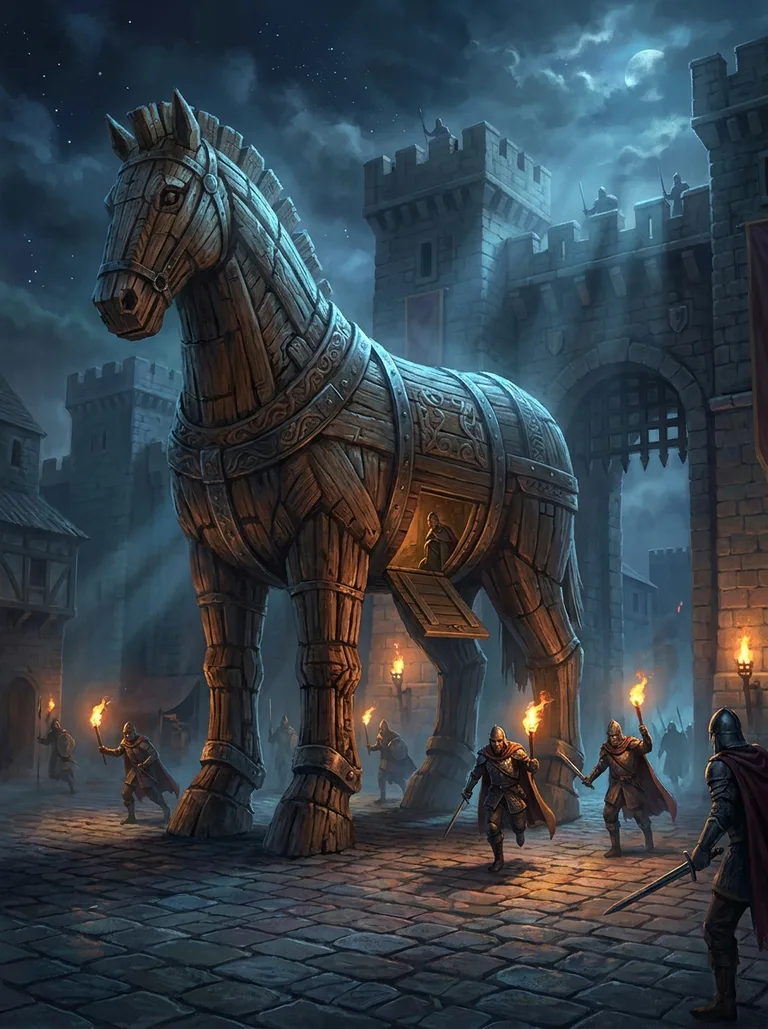
A gift too large to refuse.
- Rarity
- Common
- Category
- Trap
- Effect
- Destroys the attacking monster.
The myth
After ten years of besieging Troy, the Greeks won by cunning. In the Odyssey, the singer Demodocus tells how Epeius, with Athena's help, built a great wooden horse in which Odysseus and the best warriors hid while the army pretended to sail away. The Trojans hauled the horse inside their walls as an offering, and at night the warriors climbed out and opened the gates. The Odyssey also tells how Helen circled the horse imitating the voices of the hidden heroes' wives. Virgil and the Epic Cycle add Laocoon, who distrusted the gift.
Why it has this power
A Common trap that destroys the attacking monster. The enemy advances confidently, like the Trojans hauling the gift inside their walls, and is destroyed by what lay hidden. Perfect against aggressive opponents who attack without thinking about what you left face down.
Did you know
The line I fear the Greeks even bearing gifts, spoken by Laocoon, comes from Virgil's Aeneid, not from Homer.
Connections
- In Nikos the Young Hoplite's deck
- In Kaelmyr, Devourer of Pantheons's deck
Where to get it
- Comes in every duelist's starter deck.
- Daily Offering: 0% per pack (Common 64% per card)
- Welcome Pack: 0.97% per pack (Common 70% per card)
- Traveler's Pack: 0.88% per pack · 5.2% in the themed pack (Common 64% per card)
- Bronze Reliquary: 0.86% per pack · 5.1% in the themed pack (Common 62% per card)
- Silver Reliquary: 0.67% per pack · 4% in the themed pack (Common 49% per card)
- Golden Reliquary: 0.46% per pack · 2.7% in the themed pack (Common 33% per card)
- Daily Showcase: Shows up on about 0.69% of days · 150 gold
- Craft with card dust: 40 dust
- Crossing of Myths: Can be offered as a reward during a crossing (the card stays in the crossing deck).
Sources
- Trojan War (World History Encyclopedia) — Mark Cartwright
- Odyssey, Book 8 — Homer (trans. A. T. Murray), Theoi Classical Texts Library
- The Library, Epitome — Pseudo-Apollodorus (trans. J. G. Frazer), Theoi Classical Texts Library