The MYTHENOR encyclopedia
Japanese Mythology and Folklore
Who they were
Japanese mythology was born in an archipelago of mountains, forests, rivers and sea, where it is believed that anything may house a kami, a sacred presence. Its oldest accounts are in the Kojiki of 712 and the Nihon Shoki of 720, compiled by the Yamato court to tell of the world's creation, the age of the gods and the origin of the imperial house. Over the centuries this Shinto core was joined by Buddhism from China and Korea, yin-yang thought and an immensely rich folk tradition. From the Heian to the Edo period, tales, Noh and kabuki plays, illustrated scrolls and woodblock prints filled Japan with heroes, samurai, ghosts and yōkai, creatures ranging from the terrifying to the comic. Many of these beliefs remain alive in shrines, temples, festivals and today's culture.
Cosmology
In the Kojiki, deities first appear alone in Takamagahara, the Plain of High Heaven. Then comes the couple Izanagi and Izanami, charged with giving the land its shape. Standing on the Floating Bridge of Heaven, they stir the ocean with a jeweled spear, and from the falling drops the first island is born. Together they bring forth the islands of Japan and many kami: of the sea, the winds, the trees, the mountains. Giving birth to the kami of fire, Izanami dies and descends to Yomi, the gloomy land of the dead. Izanagi goes to fetch her, sees her decaying body and flees, sealing the passage with a boulder. As he purifies himself in a river, Amaterasu is born from his left eye, Tsukuyomi from his right and Susanoo from his nose. Thus the heaven of the gods, the land of the living and the world of the dead are fixed, along with the importance of purification.
Pantheon
People speak of yaoyorozu no kami, the "eight million kami", to say they are countless. At the top is Amaterasu Ōmikami, kami of the Sun, revered at Ise and regarded as ancestor of the imperial family. Her brother Susanoo, impetuous lord of storms, defeats the serpent Yamata-no-Orochi in Izumo, and Tsukuyomi rules the night. Inari protects rice and prosperity, with foxes as messengers; Hachiman is the kami of warriors; Raijin and Fūjin command thunder and wind; Ryūjin reigns beneath the sea. From Buddhism came figures such as Benzaiten, of waters and music, and the Seven Lucky Gods. Around them live local spirits of mountains, rivers and homes, and a vast people of yōkai.
In MYTHENOR
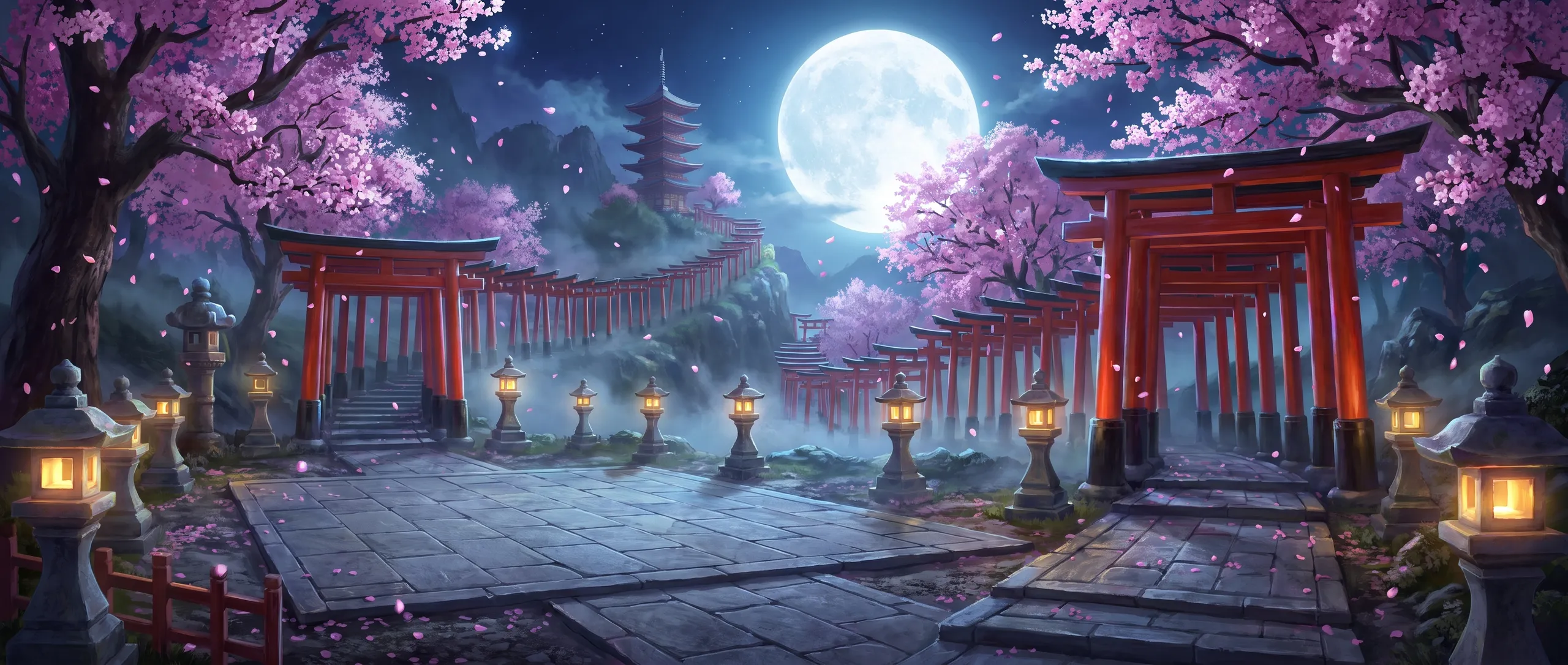
In MYTHENOR this is the region of the Archipelago of the Kami, under the Sky of Eight Million, where every thing has a kami remembered in festivals and offerings. Duels take place in shrine courtyards, beneath red torii and moonlit cherry trees. On the Eight Hills, the guardian Kaguya keeps the moonlight thread, the sword, the mirror and eight vats. But silence is coming: the lanterns will not light, the Kamo River forgets its name, the tengu forget how to fly, and something ancient is thirsty.
A note on respect
Shinto is a living religion, practiced today at tens of thousands of shrines, and many of the Buddhist and folk beliefs mentioned here are also lived by millions of people. Amaterasu, Inari, Hachiman and other kami are revered today, and rites such as Obon, kagura dances and purification are sacred practices, not game magic. MYTHENOR presents these figures with respect; when visiting a shrine, follow local customs, such as bowing before the torii and purifying your hands.
Sources
- Shinto — World History Encyclopedia — Mark Cartwright
- Kojiki: Japan's Oldest Book — World History Encyclopedia — Mark Cartwright
- Izanami and Izanagi — World History Encyclopedia — Mark Cartwright
- Kami — Encyclopaedia Britannica — The Editors of Encyclopaedia Britannica
- Introduction: Jinja — Encyclopedia of Shinto — Kokugakuin University
- The Database of Paintings of Mysterious Phenomena and Yōkai — International Research Center for Japanese Studies (Nichibunken)
The 120 cards
- Ryūjin, Lord of the Tides
- Nine-Tailed Kitsune
- Amaterasu Ōmikami, Goddess of the Sun
- Susanoo, Storm of Seas and Skies
- Well-Dragon Hatchling
- Hakone Mist Dragon
- Kurama Lightning Dragon
- Fuji Ember Dragon
- Mizuchi of the Rapids
- Kiyohime, Dragon of Jealousy
- Izumo Stormcloud Dragon
- Benzaiten's White Serpent
- Plump Tsuchinoko
- Bamboo-Grove Wind Serpent
- Uwabami, the Giant Serpent
- Nure-onna, Serpent-Woman of the Shore
- Spawn of Orochi
- Karasu-tengu Scout
- Green Pheasant of Kibi
- Grateful Crane
- Raijin's Thunderbird
- Yatagarasu, the Three-Legged Crow
- Onmoraki, Bird of the Dead
- Karura, the Celestial Fire Eagle
- Momotarō, the Peach Boy
- Tōkaidō Road Ronin
- Burning Castle Guard
- Samurai of the Blazing Blade
- Iga Shadow Ninja
- Benkei, the Warrior Monk
- Tomoe Gozen, the Mounted Archer
- Momotarō and His Companions
- Ushiwakamaru, Pupil of the Tengu
- Benkei and Yoshitsune at Gojō Bridge
- Village Trickster Tanuki
- Temple-Flame Tiger
- Bakeneko, the Shapeshifting Cat
- Raijū, the Thunder Beast
- Stone Komainu
- Inari's Fox Messenger
- Turtle of the Undersea Palace
- Nue, the Chimera of Shadows
- Shallow-River Kappa
- Red Mountain Oni
- Blue Island Oni
- Coastal Ushi-oni
- Kawatarō, Lord of the Kappa
- Shuten-dōji, King of the Oni
- Kodama, Tree Spirit
- Karakasa, the Living Umbrella
- Chōchin-obake, the Haunted Lantern
- Zashiki-warashi of the Old House
- Long-Necked Rokurokubi
- Yuki-onna, the Snow Woman
- Nurarihyon, Lord of the Yōkai
- Night Parade of One Hundred Demons
- Young Kami of the Spring
- Inari Ōkami, Lady of Rice
- Benzaiten, Goddess of Music
- Raijin, the Thunder Drummer
- Fūjin, Bearer of the Winds
- Otohime, Princess of the Dragon Palace
- Raijin and Fūjin, the Twin Tempest
- Hungry Gaki
- Funayūrei, the Drowned with Ladles
- Yūrei of the Abandoned Bridge
- Hone-onna, the Bone Woman
- Jikininki, the Corpse-Eater
- Ōkubi, the Giant Head in the Sky
- Umibōzu, the Black Sea Monk
- Apprentice Onmyōji
- Shrine Miko
- Sacred-Mountain Yamabushi
- Yamauba, the Mountain Witch
- Abe no Seimei, the Great Onmyōji
- Tamamo-no-Mae, the Golden Courtesan
- Seimei and the Twelve-Direction Shikigami
- Tea-Serving Karakuri
- Sparking-Gear Karakuri
- Walking Furnace Karakuri
- Coil-Charged Samurai Karakuri
- Bunbuku Chagama, the Tanuki Teakettle
- Young Jorōgumo of the Hidden Web
- Ancestral Guardian Sakura
- Tsuchigumo, the Earth Spider
- Jorōgumo, Lady of the Waterfall
- Yamata-no-Orochi, the Eight-Headed Serpent
- Gashadokuro, the Colossal Skeleton
- Sōjōbō, King of the Tengu
- Ōmukade, the Centipede of Mount Mikami
- Tea of the Serene Ceremony
- Ryōgoku Fireworks
- Obon Lantern Festival
- Code of Bushidō
- The Yata Mirror
- Iga Paralyzing Mist
- Ofuda Sealing Talisman
- Makimono Scroll of Secrets
- The Reversed Nō Mask
- Fox Possession
- Iaidō Draw-Cut
- Divine Wind of Ise
- Enchanted Bamboo Wall
- Hidden-Blade Tatami
- Kanashibari, Sleep Paralysis
- Onmyōji's Mirror
- Sealed Torii Gate
- Shinobi Ambush
- The Polite Bow
- Vengeance of the Betrayed Spirit
- Folded-Steel Katana
- Kanabō, the Oni's Iron Club
- Tengu Feather Fan
- Tide Jewel
- Kusanagi, the Grass-Cutting Sword
- Red Torii Shrine by Moonlight
- Eight Vats of Sake
- Rite of the Forgotten Battlefield
- Rite of Mount Kurama
- Rite of Mount Mikami