Japanese · No. 045
Blue Island Oni
Real myth
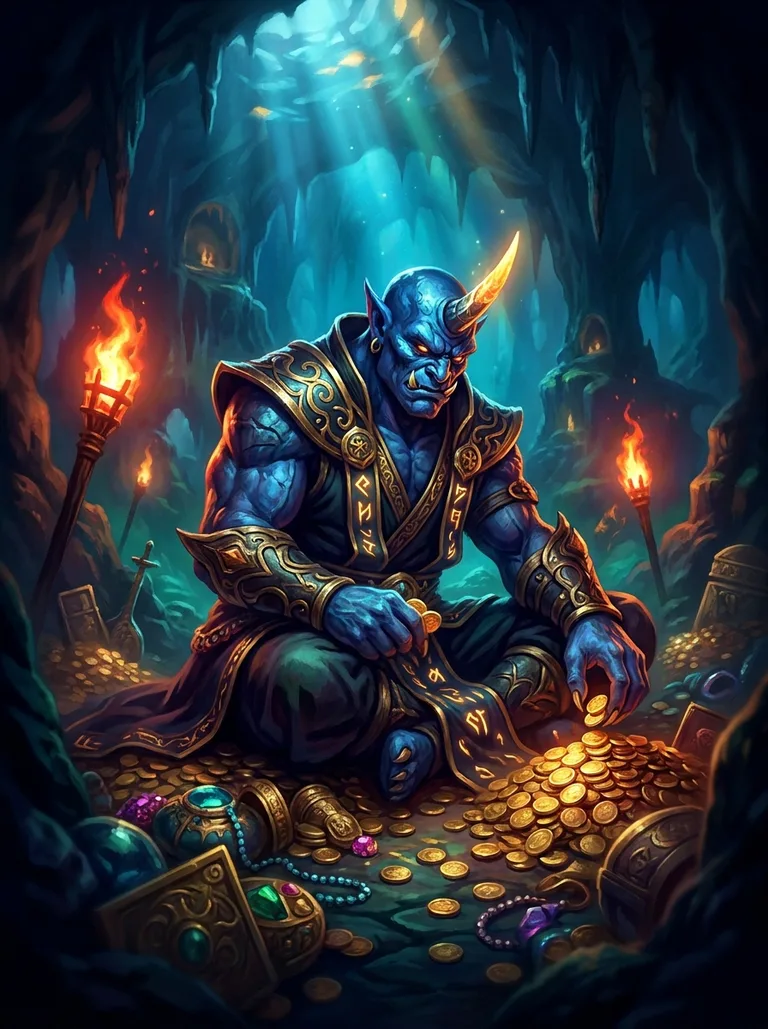
It guards the stolen treasure and counts every coin.
- Rarity
- Common
- Category
- Monster
- ATK
- 1400
- DEF
- 1300
- Level
- 4
- Type
- Beast-Warrior
- Element
- Darkness
- Constellations
- Moon · Bull
The myth
Blue oni, alongside red ones, are the most common pair of demons in Japanese art and festivals. In the tale of Momotarō the oni live on Onigashima, the Island of Demons, where they hoard treasure plundered from villages, and are forced to give it back. Blue also appears in Buddhist depictions of the hells, where oni of different colors serve as jailers. A much-loved modern tale, The Red Oni Who Cried, from 1933, shows a blue oni who pretends to be wicked so his red friend can be accepted by humans.
Why it has this power
A Common level-4 Darkness Beast-Warrior with 1400 ATK and 1300 DEF: a little less aggressive than his red brother, but steadier. Darkness and Moon come from the distant, dark island; Bull, rare in the archipelago, recalls the horns and stubbornness of one who counts every coin. Gains 500 with the Oni's Kanabō.
Did you know
In Hamada Hirosuke's The Red Oni Who Cried, the blue oni leaves a farewell letter, and his friendship is still remembered in Japanese school books.
Connections
- In Kenji, Kamo River Fisherman's deck
- In Renji, Ronin of the Snowy Roads's deck
- In Kaguya, Guardian of the Torii's deck
Where to get it
- Daily Offering: 0% per pack (Common 64% per card)
- Welcome Pack: 0.97% per pack (Common 70% per card)
- Traveler's Pack: 0.88% per pack · 5.2% in the themed pack (Common 64% per card)
- Bronze Reliquary: 0.86% per pack · 5.1% in the themed pack (Common 62% per card)
- Silver Reliquary: 0.67% per pack · 4% in the themed pack (Common 49% per card)
- Golden Reliquary: 0.46% per pack · 2.7% in the themed pack (Common 33% per card)
- Daily Showcase: Shows up on about 0.69% of days · 150 gold
- Craft with card dust: 40 dust
- Crossing of Myths: Can be offered as a reward during a crossing (the card stays in the crossing deck).
Sources
- Japanese Fairy Tales (Project Gutenberg) — Yei Theodora Ozaki
- Oni — Encyclopedia of Shinto — Kokugakuin University