Japanese · No. 039
Stone Komainu
Real myth
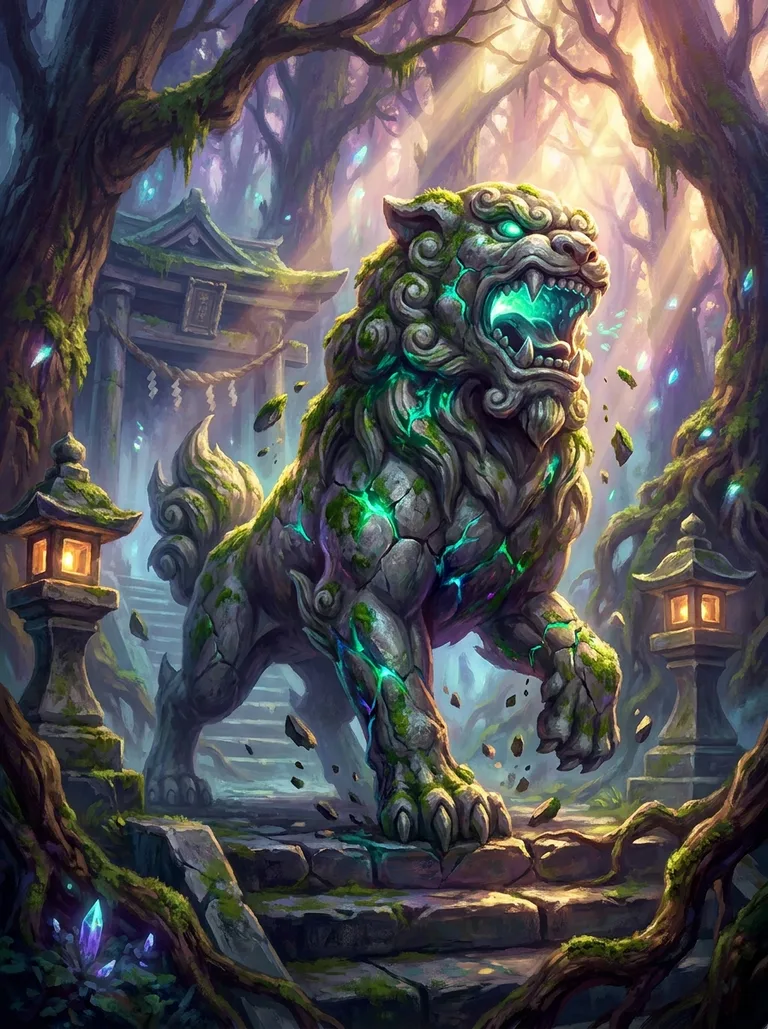
One with its mouth open, the other closed. Together they say everything.
- Rarity
- Uncommon
- Category
- Monster
- ATK
- 1600
- DEF
- 1800
- Level
- 5
- Type
- Beast
- Element
- Earth
- Constellations
- Feather · Fox
The myth
Komainu are the paired guardian statues placed at the entrance of Shinto shrines, by the torii or along the approach. Resembling lions or dogs, they reached Japan from Tang-dynasty China, and the name, "dog of Koma", alludes to Korea, through which they passed. Usually one has an open mouth and the other a closed one, the a-un posture, evoking the first and last letters of the Sanskrit alphabet, the beginning and end of all things. Together they symbolize driving out evil and protecting sacred space. Many are stone; others are bronze or wood.
Why it has this power
An Uncommon level-5 Earth Beast with 1600 ATK and 1800 DEF: a guardian, made to endure rather than hunt. Earth is the stone it is carved from; Feather and Fox recall the lightness of blessing and the cunning of a watcher. A solid wall for the early turns.
Did you know
At Inari shrines the komainu's place is usually taken by foxes, and elsewhere there are guardians shaped like wolves, monkeys or rabbits.
Connections
- In Kenji, Kamo River Fisherman's deck
Where to get it
- Comes in every duelist's starter deck.
- Campaign drop: Aiko, Dojo Apprentice (Archipelago of the Kami) — grade S: 25% · grade A: 17%
- Daily Offering: 0.45% per pack (Uncommon 33% per card)
- Welcome Pack: 1.1% per pack (Uncommon 30% per card)
- Traveler's Pack: 0.96% per pack · 5.6% in the themed pack (Uncommon 29% per card)
- Bronze Reliquary: 0.94% per pack · 5.5% in the themed pack (Uncommon 29% per card)
- Silver Reliquary: 0.96% per pack · 5.6% in the themed pack (Uncommon 33% per card)
- Golden Reliquary: 0.94% per pack · 5.5% in the themed pack (Uncommon 35% per card)
- Daily Showcase: Shows up on about 0.98% of days · 400 gold
- Craft with card dust: 100 dust
- Crossing of Myths: Can be offered as a reward during a crossing (the card stays in the crossing deck).
Sources
- Komainu — Encyclopedia of Shinto — Kokugakuin University
- Komainu — Encyclopaedia Britannica — The Editors of Encyclopaedia Britannica