Japanese · No. 025
Momotarō, the Peach Boy
Real myth
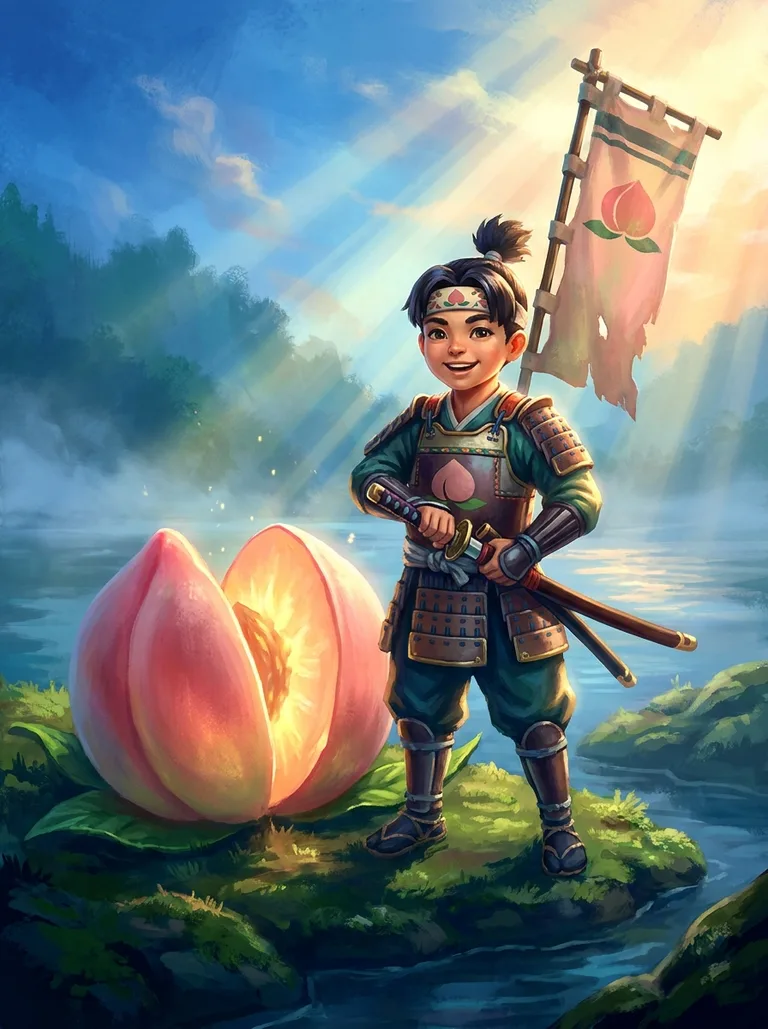
Born from a peach, he set off for the demons' island with dumplings.
- Rarity
- Common
- Category
- Monster
- ATK
- 1200
- DEF
- 1000
- Level
- 3
- Type
- Warrior
- Element
- Light
- Constellations
- Sun · Hammer
The myth
Momotarō, the Peach Boy, is the hero of Japan's best-known folktale. A childless old couple find a huge peach floating down the river; when they open it, a boy appears. Grown up, he sets out for Onigashima, the Island of Demons, carrying kibi-dango made by his mother. On the way he shares the dumplings with a dog, a monkey and a pheasant, who help him defeat the oni and bring back their treasure. The peach is no accident: the Nihon Shoki already tells how Izanagi drove off pursuers from the land of the dead by throwing peaches.
Why it has this power
A Common level-3 Light Warrior with 1200 ATK and 1000 DEF: a boy, but with a hero's heart. Light and the Sun constellation come from the peach, a fruit that repels demons; Hammer recalls warrior strength. His real power is gathering friends: fused with any Beast, he becomes Momotarō and His Companions.
Did you know
The city of Okayama adopted Momotarō as its symbol, with a statue at the station, and sells kibi-dango as the region's signature sweet.
Connections
- Fuses into: + Beast → Momotarō and His Companions
- In Hanae, Wandering Miko's deck
- In Renji, Ronin of the Snowy Roads's deck
Where to get it
- Campaign drop: Aiko, Dojo Apprentice (Archipelago of the Kami) — grade C: 13% · grade D: 13%
- Daily Offering: 0% per pack (Common 64% per card)
- Welcome Pack: 0.97% per pack (Common 70% per card)
- Traveler's Pack: 0.88% per pack · 5.2% in the themed pack (Common 64% per card)
- Bronze Reliquary: 0.86% per pack · 5.1% in the themed pack (Common 62% per card)
- Silver Reliquary: 0.67% per pack · 4% in the themed pack (Common 49% per card)
- Golden Reliquary: 0.46% per pack · 2.7% in the themed pack (Common 33% per card)
- Daily Showcase: Shows up on about 0.69% of days · 150 gold
- Craft with card dust: 40 dust
- Crossing of Myths: Can be offered as a reward during a crossing (the card stays in the crossing deck).
Sources
- Japanese Fairy Tales (Project Gutenberg) — Yei Theodora Ozaki
- Momotaro — Folk Legends, Kids Web Japan — Ministry of Foreign Affairs of Japan (Web Japan)
- Oni — Encyclopedia of Shinto — Kokugakuin University