Tupi · No. 081
Living Anthill
Inspired by: Leafcutter ants, which farm fungus in underground cities.
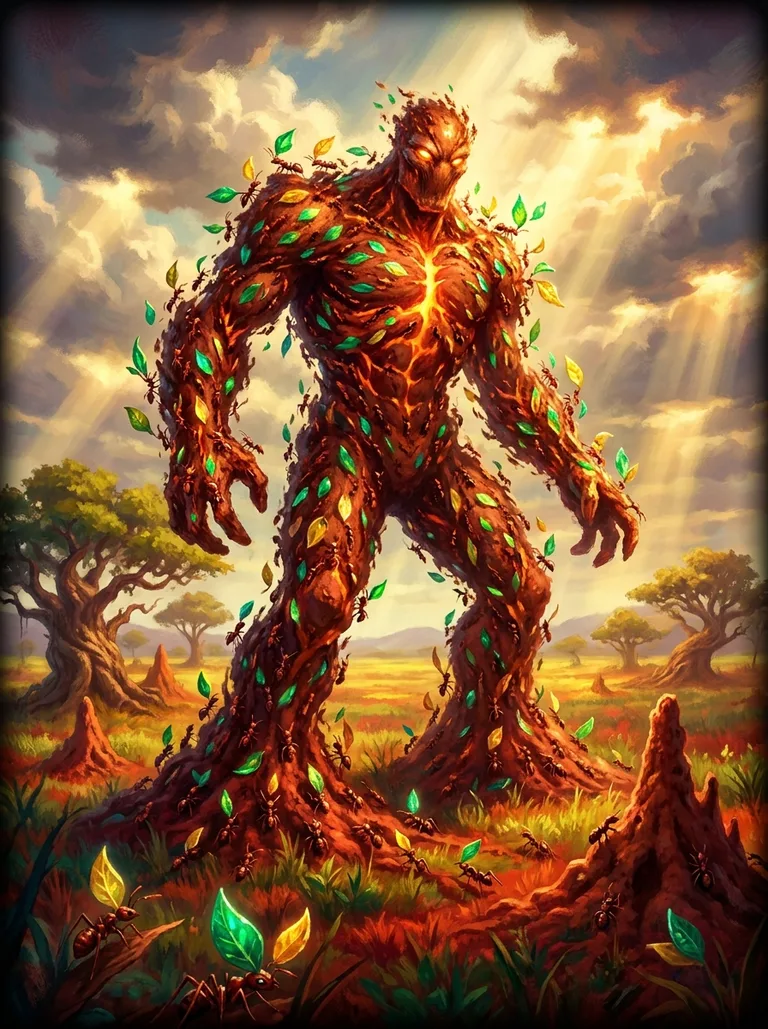
A million ants thinking the same thought.
- Rarity
- Common
- Category
- Monster
- ATK
- 900
- DEF
- 1200
- Level
- 3
- Type
- Insect-Plant
- Element
- Earth
- Constellations
- Feather · Scarab
The myth
The Living Anthill is a MYTHENOR creation inspired by the saúvas, Brazil's leafcutter ants. They cut pieces of leaves and carry them in lines to underground nests that can hold millions of individuals and span many meters of soil. But they do not eat the leaves: they use them to farm a fungus, which is their food. Each ant has a task, and the colony works as a single body. The word saúva comes from Tupi. In some regions, such as the Paraíba Valley, the winged queens, called içás, are gathered and eaten toasted, a custom of Indigenous origin.
Why it has this power
A level 3 common with ATK 900 and DEF 1200: more defense than attack, like a colony that protects itself together. It is an earth-element Insect or Plant that lives underground. Feather and Scarab join the flight of the queens and the world of insects. Fused with the Giant Anteater, it becomes Anteater, King of the Termite Mounds.
Did you know
Leafcutter ants have practiced farming for millions of years, long before humans.
Connections
- Fuses into: + Giant Anteater → Anteater, King of the Termite Mounds
- In Yaraci, Forest Apprentice's deck
Where to get it
- Campaign drop: Yaraci, Forest Apprentice (Heart of the Forest) — grade B: 14% · grade C: 13% · grade D: 13%
- Daily Offering: 0% per pack (Common 64% per card)
- Welcome Pack: 0.97% per pack (Common 70% per card)
- Traveler's Pack: 0.88% per pack · 5.2% in the themed pack (Common 64% per card)
- Bronze Reliquary: 0.86% per pack · 5.1% in the themed pack (Common 62% per card)
- Silver Reliquary: 0.67% per pack · 4% in the themed pack (Common 49% per card)
- Golden Reliquary: 0.46% per pack · 2.7% in the themed pack (Common 33% per card)
- Daily Showcase: Shows up on about 0.69% of days · 150 gold
- Craft with card dust: 40 dust
- Crossing of Myths: Can be offered as a reward during a crossing (the card stays in the crossing deck).
Sources
- Saúva — Wikipédia