Tupi · No. 038
Giant Anteater
Inspired by: The real giant anteater, whose Brazilian name comes from Tupi.
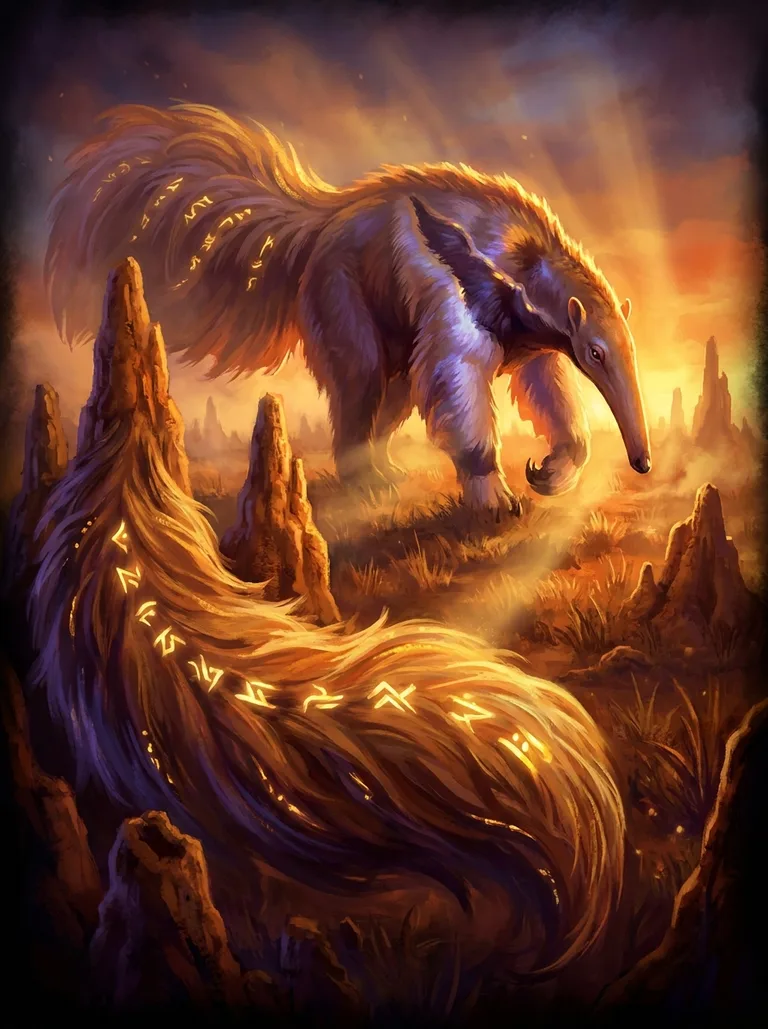
It has no teeth. It doesn't need any.
- Rarity
- Common
- Category
- Monster
- ATK
- 1000
- DEF
- 1000
- Level
- 3
- Type
- Beast
- Element
- Earth
- Constellations
- Sun · Bull
The myth
The giant anteater is a real animal of the Cerrado, the Pantanal and Brazil's forests, and its Brazilian name comes from Tupi. It has no teeth: it uses a long, sticky tongue to eat thousands of ants and termites a day, visiting many nests without wiping any out. The huge claws on its front feet open termite mounds and also serve for defense; the anteater's embrace is famous in rural Brazil, and there are accounts of it standing up even to jaguars. Its long, flag-like tail gives it its Brazilian name. The card is a MYTHENOR creation celebrating this calm animal.
Why it has this power
A level 3 common with ATK 1000 and DEF 1000: balanced and calm. It is an earth-element Beast that lives digging into termite mounds. Sun and Bull are open grassland and the strength of its claws. Fused with the Living Anthill, it becomes Anteater, King of the Termite Mounds.
Did you know
A giant anteater's tongue can exceed half a meter and flick in and out more than a hundred times a minute.
Connections
- Fuses into: + Living Anthill → Anteater, King of the Termite Mounds
- In Yaraci, Forest Apprentice's deck
- In Jaci-Miri, Sentinel of the Forest's deck
Where to get it
- Campaign drop: Yaraci, Forest Apprentice (Heart of the Forest) — grade B: 14% · grade C: 13% · grade D: 13%
- Daily Offering: 0% per pack (Common 64% per card)
- Welcome Pack: 0.97% per pack (Common 70% per card)
- Traveler's Pack: 0.88% per pack · 5.2% in the themed pack (Common 64% per card)
- Bronze Reliquary: 0.86% per pack · 5.1% in the themed pack (Common 62% per card)
- Silver Reliquary: 0.67% per pack · 4% in the themed pack (Common 49% per card)
- Golden Reliquary: 0.46% per pack · 2.7% in the themed pack (Common 33% per card)
- Daily Showcase: Shows up on about 0.69% of days · 150 gold
- Craft with card dust: 40 dust
- Crossing of Myths: Can be offered as a reward during a crossing (the card stays in the crossing deck).
Sources
- Tamanduá-bandeira — Wikipédia