Tupi · No. 076
Marajoara Ceramic Sentinel
Inspired by: Marajoara pottery, made on Marajó Island roughly between 400 and 1400 CE.
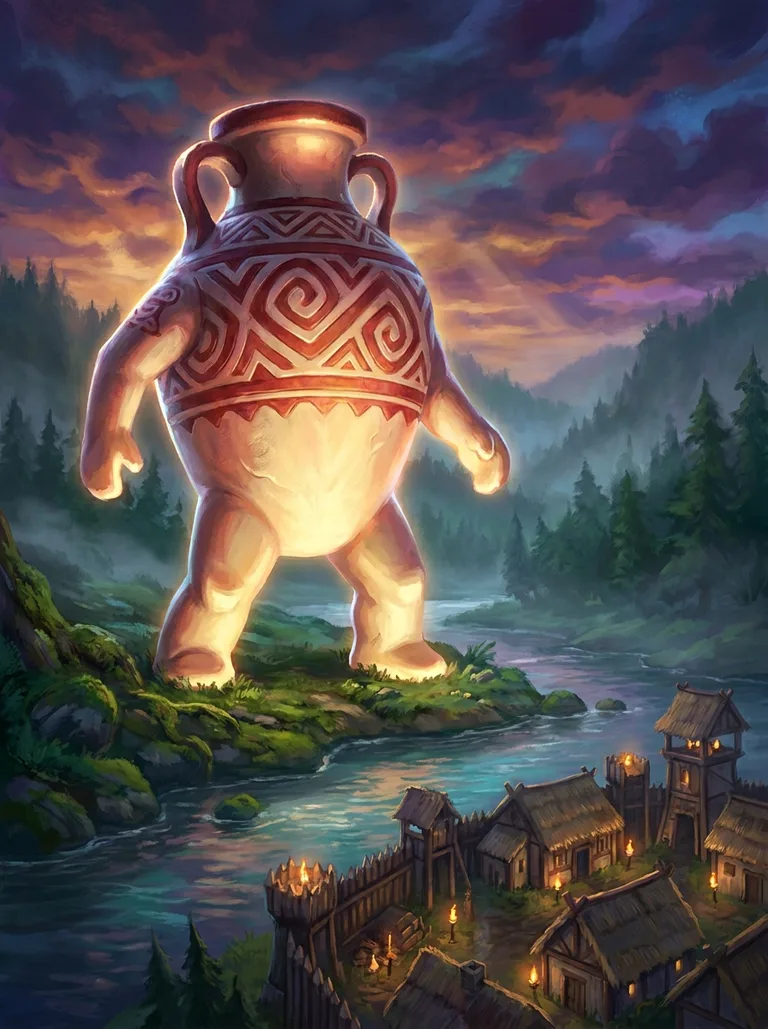
The patterns on the vase grew legs.
- Rarity
- Common
- Category
- Monster
- ATK
- 1450
- DEF
- 1400
- Level
- 4
- Type
- Machine
- Element
- Earth
- Constellations
- Sun · Hammer
The myth
Marajoara culture flourished on Marajó Island at the mouth of the Amazon, in present-day Pará, roughly between 400 and 1400 CE, before Europeans arrived. Its people built large earthen mounds, the tesos, which protected villages from floods, and produced some of the most sophisticated pottery in the Americas: great funerary urns with faces and geometric designs painted in red, black and white, as well as small ceramic pubic covers. The Marajoara were not a Tupi people, and they left no writing. The card's sentinel is a MYTHENOR creation: the designs on the vessel grew legs.
Why it has this power
A level 4 common with ATK 1450 and DEF 1400: solid and balanced, like a well-fired pot. It is an earth-element Machine, made of clay. Sun and Hammer are the kiln and the work of the hands that shaped it. One of the region's best commons for holding the field.
Did you know
Artisans in Icoaraci, Belém, still keep alive a pottery tradition inspired by Marajoara designs.
Connections
- In Yaraci, Forest Apprentice's deck
Where to get it
- Campaign drop: Yaraci, Forest Apprentice (Heart of the Forest) — grade B: 14% · grade C: 13% · grade D: 13%
- Daily Offering: 0% per pack (Common 64% per card)
- Welcome Pack: 0.97% per pack (Common 70% per card)
- Traveler's Pack: 0.88% per pack · 5.2% in the themed pack (Common 64% per card)
- Bronze Reliquary: 0.86% per pack · 5.1% in the themed pack (Common 62% per card)
- Silver Reliquary: 0.67% per pack · 4% in the themed pack (Common 49% per card)
- Golden Reliquary: 0.46% per pack · 2.7% in the themed pack (Common 33% per card)
- Daily Showcase: Shows up on about 0.69% of days · 150 gold
- Craft with card dust: 40 dust
- Crossing of Myths: Can be offered as a reward during a crossing (the card stays in the crossing deck).
Sources
- Cultura marajoara — Wikipédia