Tupi · No. 017
Ancestral Anaconda of the Deep Lagoon
Inspired by: The real anaconda and Amazonian beliefs about giant snakes living at the bottom of rivers and lakes.
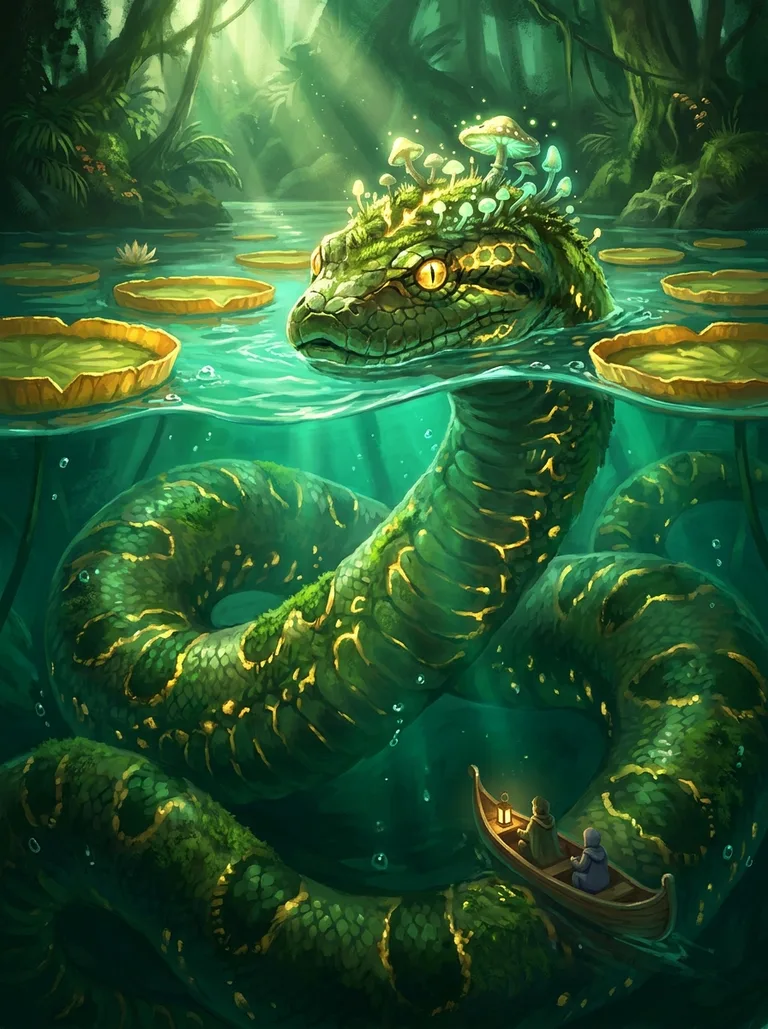
She is as old as the lagoon. And just as big.
- Rarity
- Epic
- Category
- Monster
- ATK
- 2700
- DEF
- 2800
- Level
- 8
- Type
- Serpent
- Element
- Water
- Constellations
- Moon · Leviathan
The myth
The green anaconda, called sucuri in Brazil, is a real snake of the waters of the Amazon and the Pantanal and one of the heaviest snakes in the world. It lives in lagoons, slow rivers and flooded land, waiting underwater with only its eyes and nostrils showing, and kills by constriction. Its Brazilian name comes from Tupi. All across the Amazon, old anacondas blend into stories of the Great Snake, the Boiúna: people say a snake that grows very old swells to the size of its lake, and that its movements below change the course of the waters. The card joins the real animal and that ancient respect.
Why it has this power
A level 8 epic with ATK 2700 and DEF 2800: defense higher than attack shows a strength that waits and squeezes. It is a water-element Serpent, with Moon and Leviathan, the marks of the great river snakes. It is the highest step before the Boiúna among the region's serpents.
Did you know
Female anacondas are much larger than males, and can exceed five meters in length.
Connections
Where to get it
- Daily Offering: 0.012% per pack (Epic 0.15% per card)
- Traveler's Pack: 0.045% per pack · 0.2% in the themed pack (Epic 0.24% per card)
- Bronze Reliquary: 0.18% per pack · 0.83% in the themed pack (Epic 1% per card)
- Silver Reliquary: 0.49% per pack · 2.2% in the themed pack (Epic 3% per card)
- Golden Reliquary: 0.91% per pack · 4.1% in the themed pack (Epic 6% per card)
- Daily Showcase: Shows up on about 2.6% of days · 1,500 gems
- Craft with card dust: 2,400 dust
- Crossing of Myths: Can be offered as a reward during a crossing (the card stays in the crossing deck).
Sources
- Sucuri-verde — Wikipédia
- Cobra-grande — Wikipédia