Aztec · No. 037
Singing Coyote
Inspired by: A MYTHENOR creation inspired by the coyote, an important animal in Nahua culture and linked to Huehuecóyotl, god of music and dance.
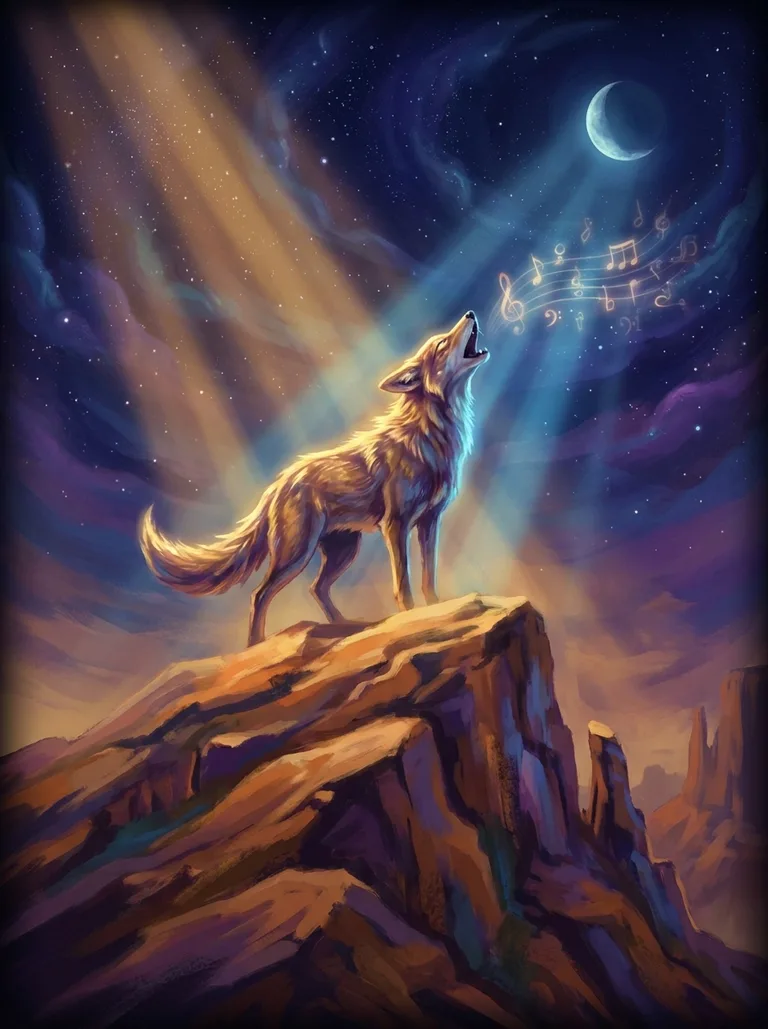
It sings at night to the gods. Sometimes the gods answer.
- Rarity
- Common
- Category
- Monster
- ATK
- 1100
- DEF
- 800
- Level
- 3
- Type
- Beast
- Element
- Earth
- Constellations
- Feather · Bull
The myth
The word coyote comes from Nahuatl coyotl. For the Mexica the animal had two faces: cunning and dangerous, a symbol of warrior ferocity, yet also capable of gratitude and protection. The Florentine Codex tells of a coyote that, rescued by a traveler, began bringing him turkeys in thanks. The coyote is also the animal of Huehuecóyotl, the “Old Coyote,” god of music, dance and merriment, and Tezcatlipoca sometimes disguised himself as a coyote. The singing coyote’s night howl is the game’s poetic reading.
Why it has this power
A Level 3 Common with 1100 ATK and 800 DEF: agile and cheeky. Earth is the plain where it hunts; Feather recalls the song rising to the sky, and Bull, the beasts. Its charm is in fusion: joined with any Spirit, it becomes Huehuecóyotl, the Old Coyote, god of music and dance.
Did you know
The name of Texcoco’s wise poet-king, Nezahualcóyotl, means “hungry coyote” or “fasting coyote.”
Connections
- Fuses into: + Spirit → Huehuecóyotl, the Old Coyote
- In Tlali, Calmécac Student's deck
Where to get it
- Campaign drop: Tlali, Calmécac Student (Valley of the Fifth Sun) — grade B: 14% · grade C: 13% · grade D: 13%
- Daily Offering: 0% per pack (Common 64% per card)
- Welcome Pack: 0.97% per pack (Common 70% per card)
- Traveler's Pack: 0.88% per pack · 5.2% in the themed pack (Common 64% per card)
- Bronze Reliquary: 0.86% per pack · 5.1% in the themed pack (Common 62% per card)
- Silver Reliquary: 0.67% per pack · 4% in the themed pack (Common 49% per card)
- Golden Reliquary: 0.46% per pack · 2.7% in the themed pack (Common 33% per card)
- Daily Showcase: Shows up on about 0.69% of days · 150 gold
- Craft with card dust: 40 dust
- Crossing of Myths: Can be offered as a reward during a crossing (the card stays in the crossing deck).
Sources
- Coyote (Mexicolore) — Ian Mursell
- Aztec Pantheon — World History Encyclopedia — Mark Cartwright