Aztec · No. 120
Rite of the Serpent Skirt
Inspired by: A MYTHENOR creation inspired by Coatlicue, goddess of the serpent skirt, and by the earth’s symbols: serpent, thorn and bone.
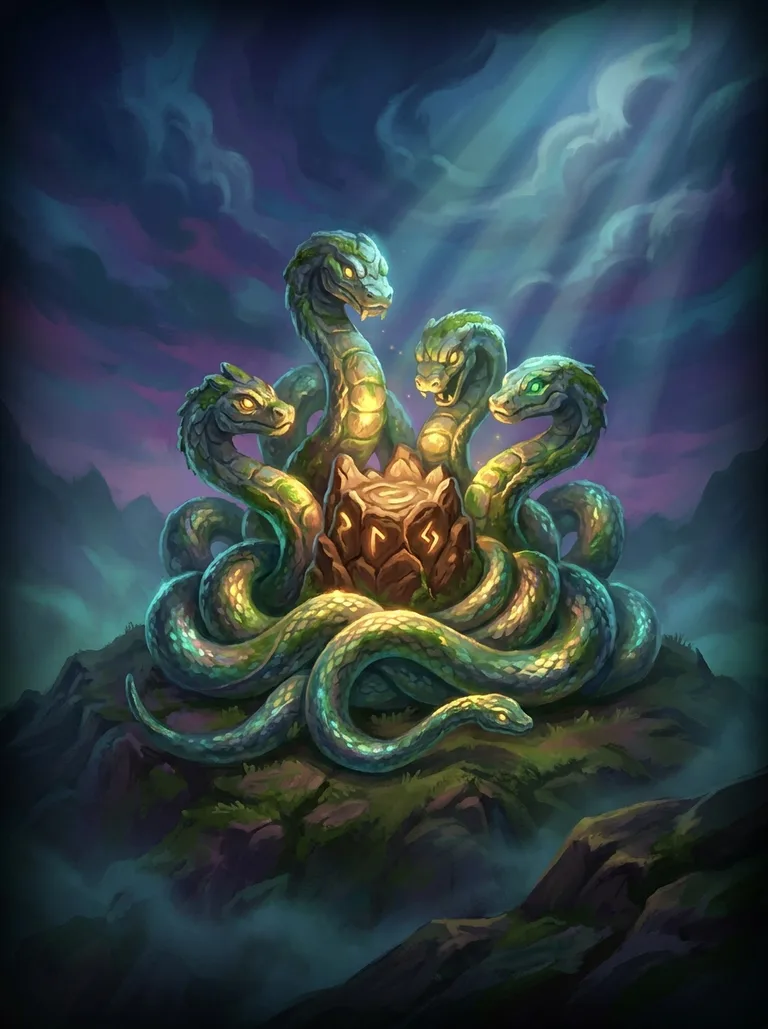
Serpent, thorn and bone: everything the earth keeps.
- Rarity
- Uncommon
- Category
- Ritual
- Effect
- Sacrifice 3 monsters with the right materials to summon a ritual monster.
The myth
Coatlicue, the earth mother, gathers in her image everything the earth holds: the skirt of intertwined serpents, the claws, the necklace of hands and hearts and, in some depictions, skulls. For the Mexica the earth was at once a mother who gives life and a mouth that devours the dead. The maguey, whose spines were used in self-sacrifice, was also sacred and tied to earth goddesses. There is no Mexica rite called “of the serpent skirt”: this ritual is the game’s creation, joining serpent, thorn and bone to summon the goddess.
Why it has this power
An Uncommon ritual: sacrifice the Jade-Rattle Rattlesnake, the Sacred Agave and the Bone Walker of Mictlán to summon Coatlicue, with 2800 ATK and 3000 DEF. Serpent, thorn and bone: everything the earth keeps. It is the only ritual in this mythology that summons a Level 9 monster.
Did you know
The Coatlicue sculpture stands about 3.5 meters tall and was found the same year as the Sun Stone, 1790.
Connections
Where to get it
- Daily Offering: 0.45% per pack (Uncommon 33% per card)
- Welcome Pack: 1.1% per pack (Uncommon 30% per card)
- Traveler's Pack: 0.96% per pack · 5.6% in the themed pack (Uncommon 29% per card)
- Bronze Reliquary: 0.94% per pack · 5.5% in the themed pack (Uncommon 29% per card)
- Silver Reliquary: 0.96% per pack · 5.6% in the themed pack (Uncommon 33% per card)
- Golden Reliquary: 0.94% per pack · 5.5% in the themed pack (Uncommon 35% per card)
- Daily Showcase: Shows up on about 0.98% of days · 400 gold
- Craft with card dust: 100 dust
Sources
- Coatlicue — World History Encyclopedia — Mark Cartwright
- En manos de Coatlicue (Arqueología Mexicana) — Iliana Godoy
- El maguey. Mitología y ritos (Arqueología Mexicana) — Enrique Vela